eCommerce
eCommerce Development in Qatar
eCommerce development in Qatar (2026): platforms, features, QAR costs, payments, SEO tips, timelines, and a free store cost calculator for Doha brands.
2026-08-04 · 22 min read
eCommerce Cost Calculator (Qatar)
Pick store type, platform approach, and complexity for a directional QAR range — then validate with a real brief.
Directional estimate
QAR 10,940 – 18,934
Planning range only — not a fixed quote. Integrations, Arabic RTL, and content readiness can move the number. Request a scoped estimate.
eCommerce development in Qatar — start with how customers actually buy
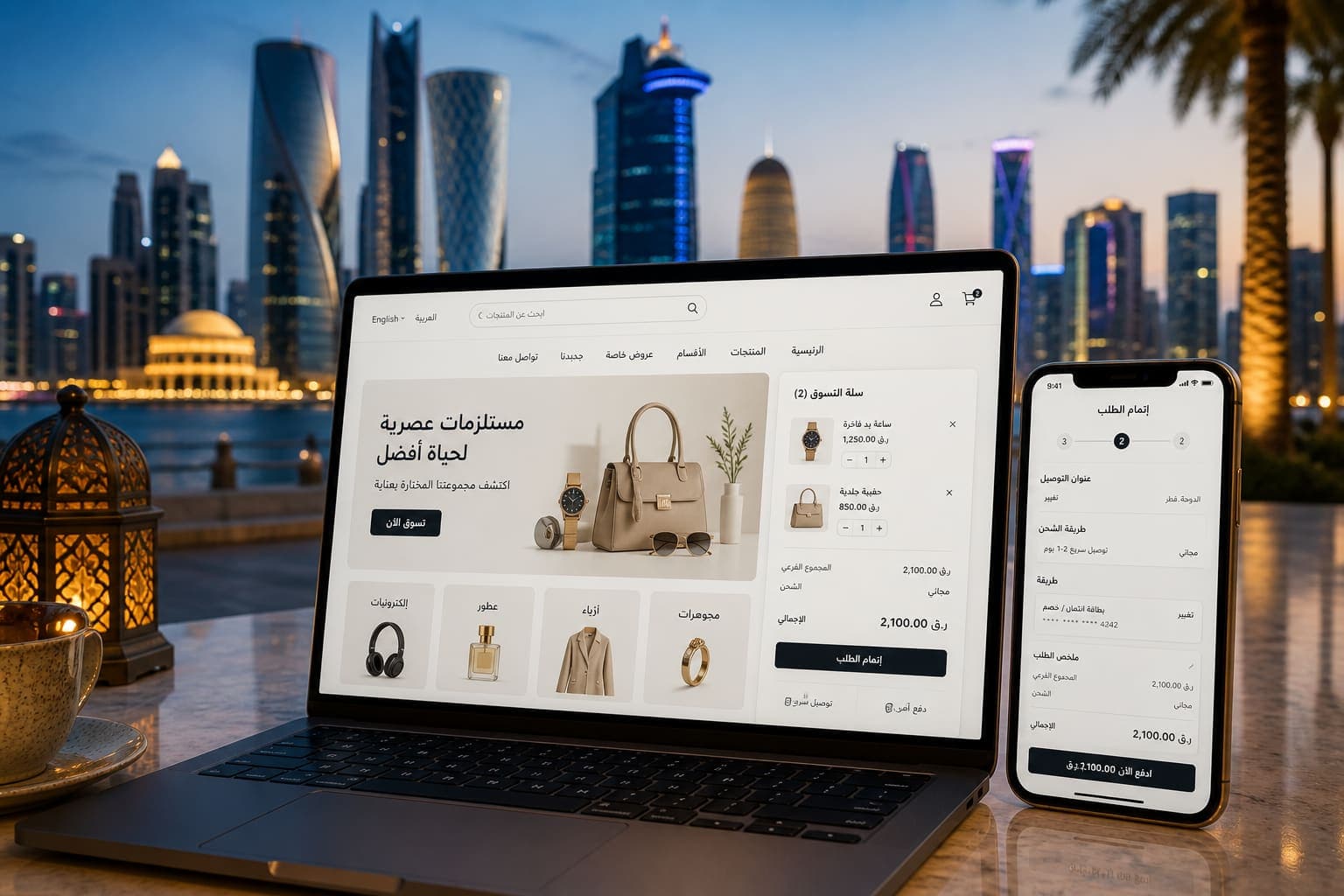
eCommerce development in Qatar is no longer a “nice extra channel.” Shoppers in Doha and across the country compare prices on their phones, expect clear delivery windows, and abandon carts when checkout feels slow or unclear. If your catalogue still lives only on Instagram DMs and WhatsApp chats, you are leaving money — and trust — on the table.
Consumer habits changed for practical reasons: people want bilingual browsing, secure local payments, order updates, and returns they can understand without calling support three times. Brands that treat the store like a serious sales system — not a brochure with an Add to Cart button — win repeat purchases.
This guide explains what eCommerce development means, which store models fit Qatar businesses, which features matter first, how to pick technology, what things roughly cost in QAR, and how to launch without expensive mistakes. It is written for entrepreneurs, retailers, startups, and enterprises who need clear decisions more than jargon.
AR + EN
Plan bilingual early
4–8 wks
Typical MVP storefront
QAR focus
Price and plan locally
What is eCommerce development?
eCommerce development is the work of planning, designing, building, testing, and improving an online selling system. That system usually includes a customer-facing website or app, a product catalogue, cart and checkout, payments, order management, and admin tools for stock and pricing.
It is more than installing a theme. Good development connects your products, inventory rules, delivery partners, payment gateways, marketing tools, and customer support into one reliable path from discover → buy → receive → repurchase.
For Qatar brands, eCommerce development also means Arabic and English readiness, RTL layout when Arabic is primary, QAR pricing, and trust cues that make buyers feel safe paying a local company online.
Why invest in eCommerce development in Qatar?
Qatar’s retail audience is digital, time-sensitive, and comfortable ordering online when the experience is polished. Delivery networks and payment options have matured enough that customers judge you against regional and global stores — not against old high-street-only habits.
Investing in a proper store helps you own the customer relationship. Marketplaces and social platforms help you get discovered, but your own website or app keeps brand, data, and margins under your control.
Professional development also reduces operational chaos. When orders sync, stock updates, and invoices stay consistent, your team spends less time fixing mistakes and more time fulfilling demand — especially during Ramadan peaks, school seasons, and big campaign weekends.
[Graph: eCommerce Market Growth in Qatar] — relative growth focus index
Illustrative planning index for where Qatar brands feel pressure to modernise
92
Mobile buying
84
Social → site
78
Same-day expect
88
Bilingual UX
74
Owned store
Benefits of an eCommerce website or mobile app
A strong storefront gives you 24/7 selling without depending on a single sales person answering messages. Customers can browse quietly, compare variants, and check out when it suits them.
You get measurable growth: conversion rate, average order value, repeat purchase rate, and which products actually move. Guesswork becomes reporting.
Apps and polished mobile websites also support loyalty — push notifications, saved addresses, reorder shortcuts — which matter more once you already have a catalogue people trust.
- Own your brand experience instead of only renting marketplace attention
- Accept structured payments instead of risky ad-hoc transfers
- Scale catalogue size without breaking WhatsApp threads
- Serve Arabic and English shoppers in one coherent journey
- Connect ads and SEO to pages that can convert, not dead ends
Types of eCommerce solutions
Not every Qatar business needs the same store model. Pick the shape that matches how you sell — and only then choose tools.
[Infographic: Customer Purchase Journey] helps here: a fashion brand’s path looks different from a B2B spare-parts wholesaler. Start with buyer journey, not with a popular platform name.
eCommerce models by business need
[Customer Purchase Journey] — match model to how buyers pay and reorder
Swipe sideways to see all columns →
| Model | Best for | Watch-outs |
|---|---|---|
| B2C store | Retail brands selling to shoppers | Photos, shipping clarity, mobile checkout |
| B2B portal | Account pricing & repeat trade buyers | Permissions, quotes, credit terms |
| Marketplace | Multi-seller platforms | Payouts, disputes, quality control |
| Wholesale | MOQs and tier pricing | Pack rules and approvals |
| Subscription | Replenishment products | Failed renewals & pause UX |
| mCommerce app | High-frequency reorders | Needs proven ops first |
B2B eCommerce
B2B stores serve companies buying from companies — restaurants ordering supplies, clinics restocking consumables, contractors buying tools by account.
They often need buyer accounts, price lists by customer group, quote-to-order flows, purchase history, and higher cart values. Checkout may allow net payment terms instead of only immediate card pay.
If your sales team currently emails Excel lists and manually creates invoices, a B2B store can cut cycle time while keeping approval rules you already use.
B2C eCommerce
B2C is the familiar retail store: individuals browse, add to cart, pay, and receive delivery. Fashion, beauty, electronics accessories, home goods, gifts, and specialty food brands fit this model well in Qatar.
Success depends on crisp product pages, trustworthy photos, transparent shipping fees, and fast mobile checkout. Social ads only work if landing pages load quickly and match the creative promise.
Multi-vendor marketplace
A marketplace lets many sellers list products under one brand umbrella. Think of a curated Qatari makers market or a specialty category hub.
Complexity jumps: seller onboarding, commission rules, payouts, disputed orders, and content quality control. Do not start here unless marketplace is the core business — it is rarely a “phase two theme tweak.”
Wholesale platforms
Wholesale platforms sit between classic B2B and catalogue retail. Buyers may need minimum order quantities, case packs, and tiered discounts.
For distributors in Qatar serving regional clients, a wholesale portal with clear MOQs and account pricing often beats sending updated PDFs every week.
Subscription-based stores
Subscriptions work when customers want replenishment — coffee, skincare, pet supplies, vitamin packs, cleaning refills. Billing repeats on a schedule with pause/skip options.
You need reliable recurring payments, reminder messages, and easy account controls. Failed renewals and silent card expiries can quietly kill revenue if nobody owns the retention loop.
Mobile commerce (mCommerce)
mCommerce is shopping primarily on phones — which is how most Qatar customers discover and buy. Your responsive website is the foundation; a native or Flutter app becomes valuable when reorder frequency and notifications justify the investment.
Many Doha brands launch a bilingual storefront first, prove paid acquisition and operations, then add an app for loyalty and speed. That sequence protects cash while you learn what shoppers actually reorder.
Essential features of an eCommerce platform
Feature lists get long fast. Prioritise what reduces purchase friction and support tickets. Fancy animation helps almost never as much as clear stock status and a short checkout.
[Website Architecture Diagram] for a typical store: storefront → cart → payment → order service → inventory → admin dashboard → notifications. Keep that spine healthy before adding optional modules.
Features by business size
MVP vs growth vs enterprise priorities
Swipe sideways to see all columns →
| Feature area | SME MVP | Growth / enterprise |
|---|---|---|
| Catalogue | Core SKUs + variants | Bulk tools, multi-warehouse |
| Checkout | Cards + clear shipping | Wallets, COD rules, split shipments |
| Accounts | Order history | Roles, company accounts, SSO |
| Promotions | Basic coupons | Complex stacking & campaigns |
| Search | Keyword + filters | Relevance tuning / merchandising |
| Analytics | Sales + top products | Cohorts, attribution, BI export |
Product management
You need structured products with variants (size, colour, pack), SKUs, bilingual titles and descriptions, images, and optional videos. Bulk import tools save weeks when catalogues grow past a few dozen items.
Category trees should match how people shop, not how your warehouse shelves are arranged — though both need mapping behind the scenes.
Smart search and filters
Shoppers abandon stores that bury products. Search should forgive spelling mistakes and understand common Arabic/English product words. Filters for price, brand, size, and availability turn browsing into finding.
For larger catalogues, invest in relevance: popular items and in-stock products should not lose to empty or discontinued SKUs.
Shopping cart
Carts should persist for logged-in users, show QAR totals clearly, and warn when an item goes out of stock before payment. Guest carts that vanish on refresh create silent revenue leaks.
Upsells belong here only when they feel helpful — matching accessories, not random products that slow checkout.
Secure checkout
Checkout is where trust is won or lost. Keep fields minimal: contact, address, payment. Show shipping cost early. Use HTTPS, clear privacy language, and familiar payment logos.
For Arabic UX, form labels and error messages must be natural, not machine-awkward. RTL layout has to keep totals and step indicators readable.
Multiple payment options
Offer the methods Qatar customers expect: major cards, and local options your gateway supports (for example debit cards and popular digital wallets where available). Cash on delivery can still matter for some categories, but it needs rules for failed attempts and high-risk orders.
Always reconcile gateway settlements with your admin orders. A “paid” green badge that finance cannot match to bank deposits is an operations debt.
Order tracking
Customers want status without chasing you: confirmed, packed, out for delivery, delivered. SMS, WhatsApp, or email updates reduce inbox load.
Even a simple timeline with realistic ETAs beats a black box after payment. When delays happen, proactive messages protect reviews.
Customer accounts
Accounts store addresses, order history, and wish lists. Optional social or OTP login can reduce password friction — but keep account recovery reliable.
For B2B, accounts carry company profiles and approved buyers. Permissions matter more than pretty dashboards.
Reviews and ratings
Reviews grow when you ask at the right time — after delivery, not at purchase. Moderate spam and abusive content. Show bilingual reviews carefully so Arabic shoppers are not drowned in English-only feedback if that mismatches your audience.
Fake reviews destroy trust faster than having few reviews. Prefer authentic volume.
Discounts and coupons
Promo codes, automatic cart rules, and seasonal sales drive acquisition — but messy stacking rules create margin accidents. Define whether codes combine with sale prices before campaign week.
Track which codes produce first-time buyers versus discount hunters who never return full price.
Inventory management
Stock accuracy is a brand promise. Overselling damages trust in a small market where word travels. Sync warehouse counts, reserve stock during checkout, and set low-stock alerts.
If you sell both online and in a physical Doha shop, unified inventory is not optional for long — it is how you avoid selling the last unit twice.
Step-by-step eCommerce development process
[Flowchart: eCommerce Development Process] usually follows: plan → research → design → build → test → launch → improve. Skipping discovery to “save time” is how brands rebuild six months later.
Development timeline planner (milestones)
- Week 0–1: brief, success metrics, catalogue sample, payment/shipping constraints
- Week 1–3: wireframes, bilingual UI kit, checkout prototype
- Week 3–7: build catalogue, cart, checkout, admin basics on staging
- Week 6–8: payment sandbox + courier rules + QA on real phones
- Launch week: soft open, analytics check, support macros ready
- Month 2–3: conversion fixes, promo tools, optional app scoping
Business planning
Write down who you sell to, average order value targets, delivery zones inside Qatar, return policy, and which products launch first. Decide if the MVP is website-only or includes a vendor/admin mobile tool.
Assign one owner for catalogue readiness. Developers cannot invent product photos, accurate Arabic titles, or legal return copy for you.
Market research
Study how competitors in Qatar present prices, shipping, and payment. Note what frustrates you as a shopper — those frustrations are opportunities.
Talk to ten real customers or retailers in your niche. Ask where they already buy online and what made them trust that store. Research beats guessing colour palettes.
UI/UX design
Design for thumbs first. Large tap targets, clear product imagery, readable QAR prices, and obvious CTAs matter more than dense decoration.
Build Arabic and English layouts as first-class experiences. RTL is not a mirror flip done overnight; spacing, icons, and numerals need review.
Prototype checkout early. Most revenue risk lives in those screens, not on the homepage banner.
Technology selection
Choose based on catalogue size, customisation needs, integrations, and internal skills — not based on what a friend launched in another country with different constraints.
Shopify and WooCommerce speed many launches. Magento or custom headless stacks suit heavier catalogues and unique workflows. Next.js and React shine when marketing experience and performance are strategic. Laravel and Node.js often power custom backends and admin tools.
Development
Build in milestones: catalogue browsing, cart, checkout+payments, order emails, admin basics, then extras. Demo with real sample products, not Lorem Ipsum perfume bottles.
Keep environments separate: staging for QA, production for live sales. Never “quick fix on live” during peak traffic without a rollback plan.
Testing
Test on real phones popular in Qatar. Check Arabic strings for overflow. Run payment tests in sandbox and a carefully controlled live smoke test.
Try failed cards, out-of-stock mid-checkout, partial COD rules, and slow networks. Support tickets teach you these cases if you do not test them first — they just teach you more painfully.
Launch
Launch quietly to friends and staff first. Confirm tax/VAT display rules you must follow, shipping rates, and support hours messaging.
Connect analytics and conversion tracking before opening paid ads. Otherwise you spend on traffic you cannot diagnose.
Ongoing maintenance
Plugins, themes, payment SDKs, and browsers change. Budget monthly care: security updates, uptime monitoring, backups, and small conversion improvements.
Stores that freeze after launch slowly become insecure and outdated. Maintenance is part of ecommerce development, not an optional afterthought.
Best technologies for eCommerce development
[Technology Comparison Diagram] is useful when comparing speed-to-launch against long-term flexibility. Below is a practical read for Qatar SMEs and growth brands — not a religious war between stacks.
Technology stack comparison
[Technology Comparison Diagram]
Swipe sideways to see all columns →
| Stack | Strength | Best fit |
|---|---|---|
| Shopify | Fast launch, managed hosting | SME B2C catalogues |
| WooCommerce | WordPress ecosystem | Content + store hybrids |
| Magento | Complex catalogues/rules | Larger retail operations |
| Next.js + API | Speed & SEO control | Custom brand experiences |
| Laravel/Node custom | Unique workflows | B2B portals & specialty ops |
| Headless | Multi-channel frontends | Teams ready for integration work |
Shopify
Shopify is strong when you want a hosted store quickly with solid themes, apps, and managed infrastructure. Many Qatar retailers start here for B2C catalogues.
Watch app fees, theme customisation limits, and unique workflow needs. If you outgrow the app ecosystem’s shape, migrating later is possible but not free — so document processes early.
Shopify vs WooCommerce vs Magento
Quick commercial comparison for Qatar launches
Swipe sideways to see all columns →
| Topic | Shopify | Woo / Magento note |
|---|---|---|
| Time to MVP | Often fastest | Woo medium; Magento slower |
| Hosting care | Mostly managed | You (or host) own more |
| Custom UX | Good within platform limits | Higher ceiling with expertise |
| Ongoing cost | Apps + plan fees | Plugins + hosting + retainers |
| When to pick | Speed and reliability first | Woo for WP; Magento for heavy retail |
WooCommerce
WooCommerce (on WordPress) suits brands that already live in WordPress content marketing and want store features on the same site. Hosting quality matters a lot — cheap hosting creates slow shops.
You own more of the stack, which means more control and more maintenance responsibility. Choose plugins carefully; overlapping coupon or shipping plugins fight each other.
Magento
Magento (Adobe Commerce ecosystem and open-source variants) fits larger catalogues, complex promotions, and multi-store setups. It needs experienced developers and serious hosting.
For a small Doha boutique launching twenty SKUs, Magento is usually overweight. For enterprise retail with heavy rules, it can be appropriate.
Next.js
Next.js is excellent for fast, SEO-friendly storefronts and content-rich commerce experiences. Teams often pair it with a headless commerce backend or custom API.
It rewards brands that care about page speed, campaign landing pages, and modern UI — especially when content teams publish often.
React
React powers interactive storefront components and many custom admin tools. Combined with a solid API, it supports unique UX that packaged themes struggle to deliver.
React alone is not “an ecommerce platform” — it is a UI layer. Plan the commerce brain (products, cart, orders) explicitly.
Node.js
Node.js backends handle APIs, realtime updates, and integration glue — payment webhooks, inventory sync, notification workers.
It pairs naturally with React/Next.js teams shipping JavaScript end to end, which can simplify hiring and knowledge sharing.
Laravel
Laravel is a proven PHP framework for custom ecommerce backends, wholesale portals, and admin systems. Many GCC teams know it well for business apps.
Choose Laravel when workflows are unique and a pure SaaS theme fight would cost more than custom logic.
Headless commerce
Headless means the frontend (site/app) is separated from the commerce engine. You get design freedom and multi-channel flexibility at the cost of more integration work.
It suits brands with strong digital teams and multi-surface plans (web + app + kiosk). For a first store with a tiny team, a coupled platform is often healthier.
eCommerce website vs mobile app
A website reaches everyone with a browser and is usually the right first product. An app wins when customers return often and value saved payments, notifications, and faster reorder paths.
Many Qatar brands run both eventually: website for acquisition and SEO, app for loyalty. Force-fitting an app first because it “feels modern” burns budget before product-market proof exists.
Website vs mobile app
Choose sequence based on reorder frequency
Swipe sideways to see all columns →
| Factor | Website | Mobile app |
|---|---|---|
| Discovery & SEO | Strong | Limited (store listings) |
| Reach | Any browser | Install required |
| Push reorders | Email/SMS/WhatsApp | Native push advantage |
| Typical first step | Yes for most brands | After website traction |
| Budget profile | Lower entry | Higher + store reviews |
Payment gateway integration
Pick a gateway that supports Qatar merchant accounts, the cards and methods your buyers use, and clear settlement reports. Confirm 3-D Secure behaviour and refund flows before launch week.
Integrate webhooks carefully so order status updates when payment succeeds, fails, or is refunded. Never mark orders paid only because a browser redirected to a “thank you” page — that can be spoofed or refreshed.
If you need help connecting payments into a custom store or mobile app, treat gateway sandbox testing as a milestone with acceptance criteria, not a vague checklist item.
SEO for eCommerce websites
SEO for stores means crawlable product and category pages, fast mobile performance, clean URL structure, unique descriptions, and internal links that help shoppers and search engines.
Write for humans first: helpful category intros, clear titles, and FAQs that answer shipping and sizing questions. Avoid doorway pages of thin duplicate SKUs.
Technical basics still win: XML sitemap, canonical tags, bilingual hreflang strategy when you run Arabic and English, and compressed images. Pair SEO services with conversion work — rankings without checkout competence waste clicks.
AI features for online stores
Practical AI features include smarter search, product recommendations, chatbot answers for shipping FAQs, and backlog tools that draft product descriptions for human editors to approve.
Start where effort saves time or lifts conversion, not where demos look flashy. Always keep humans reviewing public catalogue copy and chatbot answers that affect returns or medical claims.
If you later add recommendation engines or assistants into a custom app, measure uplift against a baseline month — otherwise you cannot tell whether the feature pays for itself.
eCommerce development cost in Qatar
eCommerce development cost in Qatar depends on platform choice, catalogue complexity, bilingual scope, payment and shipping integrations, and how custom the UX needs to be. Treat the ranges below as planning bands in QAR for 2026 — not fixed quotes.
A focused Shopify or WooCommerce launch for a modest catalogue often lands in a lower band than a custom Next.js headless build with complex B2B rules. Marketplaces and multi-warehouse logic sit higher.
[Chart: eCommerce Development Cost Breakdown] typically shows design, development, integrations, content setup, and QA as the major slices — content readiness is the hidden cost many owners forget.
Directionally, many SME storefront projects fall roughly between QAR 12,000 and QAR 55,000 for well-scoped website launches, while custom growth builds and app + admin systems often move into QAR 55,000–180,000+. Enterprise and multi-vendor platforms go beyond that with phased budgets.
[Chart: eCommerce Development Cost Breakdown] — planning bands (QAR)
Directional 2026 ranges for Qatar storefront programmes
Theme MVP store
4–7 weeks
QAR 12,000 – 28,000
Growth bilingual store
7–12 weeks
QAR 28,000 – 70,000
Custom / headless
3–6 months
QAR 70,000 – 160,000
App + commerce backend
4–8 months
QAR 90,000 – 220,000
Where ecommerce budgets usually go
Illustrative share for a growth bilingual storefront
UX + UI design
18%
Bilingual screens
Frontend build
28%
Store + checkout
Backend / CMS
22%
Catalogue & orders
Payments & shipping
14%
Integrations
QA + launch
10%
Devices & sandboxes
Content support
8%
Structure & imports
Business problems vs ecommerce solutions
Turn operational pain into a scoped build item
Swipe sideways to see all columns →
| Business problem | Store capability | Business impact |
|---|---|---|
| WhatsApp-only sales chaos | Catalogue + checkout | Fewer missed orders |
| Stock mismatches | Inventory sync | Fewer cancellations |
| Low mobile conversion | Checkout UX redesign | Higher completion rate |
| No repeat purchases | Accounts + reorder | Better LTV |
| Ad spend waste | Fast PDP + tracking | Clearer CAC |
eCommerce cost calculator for Qatar
Use the calculator below for a directional QAR range. Adjust store type, platform approach, and complexity — then validate with a real brief including sample SKUs, languages, and payment preferences.
Development timeline
Timelines shrink when content is ready and expand when payments, Arabic copy, or logistics rules arrive late.
Typical patterns: theme-based MVP storefront 4–8 weeks; custom growth store 8–16 weeks; marketplace or heavy B2B 4–9+ months in phases. Apps add their own store-review and QA overhead.
[Flowchart: eCommerce Development Process] should include buffer for payment go-live and courier account setup — those are outside pure coding but they block revenue.
Development timeline by approach
Assumes content and merchant accounts are moving in parallel
Swipe sideways to see all columns →
| Approach | Typical duration | Launch outcome |
|---|---|---|
| Shopify / Woo MVP | 4–8 weeks | Sell core SKUs online |
| Custom growth store | 8–16 weeks | Deeper UX + integrations |
| B2B portal | 3–6 months | Accounts & price lists |
| Marketplace v1 | 5–9+ months | Phased seller tools |
| Add mobile app | +10–16 weeks | After website proof |
Common mistakes to avoid
Launching with unfinished Arabic, hidden shipping fees, or unpaid invoice workflows creates support fire drills on day one.
Buying every plugin “just in case” slows the site and creates conflicts. Underpricing photography and product data is another classic — empty shelves look empty online too.
Skipping staging tests with real payment sandboxes, ignoring mobile speed, and running ads before analytics and pixels are verified are expensive habits.
Cost and risk drivers
Future trends in eCommerce
Expect more conversational commerce (WhatsApp-assisted buying with a real store of record), better personalisation, faster storefronts, and tighter links between social discovery and owned checkout.
Retail media thinking — using your own traffic data carefully — will matter for brands that build audiences, not only rent them. Accessibility and clearer sustainability claims will also influence trust.
Qatar brands that invest in clean data (products, customers, inventory) will adopt new features faster than brands whose catalogues are chaos dressed as a website.
eCommerce development checklist
Use this checklist before you sign a build contract. Gaps here become change requests later.
Business readiness & launch checklist
- Ideal customer and first 50–200 SKUs defined
- Arabic + English fields owned by a named person
- Payment merchant account application started
- Delivery zones, fees, and cut-off times written down
- Return/refund policy drafted in plain language
- Product photos and variant data at least 70% complete
- Analytics + pixel plan documented before ads
- Support channel (WhatsApp/email) staffed for launch week
- Staging sign-off checklist completed on real devices
- Backup, SSL, and update ownership assigned
Feature requirement checklist
- Guest checkout + optional accounts
- QAR pricing and tax display rules confirmed
- Card payments live-tested (sandbox + controlled live)
- Order emails/SMS/WhatsApp templates reviewed
- Inventory reserve-at-checkout behaviour agreed
- Coupon rules with stacking policy
- Basic SEO titles/meta for categories
- Admin roles for catalogue vs finance
- Refund path documented
- Performance budget for mobile homepage
Growth strategy planner (first 90 days after launch)
- Week 1–2: fix top checkout drop-off reasons from heatmaps/session notes
- Week 3–4: expand best-selling category depth; remove dead SKUs
- Week 5–6: retarget carts; test free-shipping threshold if margins allow
- Week 7–8: collect reviews; improve PDP photos for top 20 SKUs
- Week 9–10: SEO content for 5 buying-intent categories
- Week 11–12: decide app vs loyalty vs marketplace experiments with data
How to choose the right partner for eCommerce development in Qatar
Look for proof of bilingual delivery, payment integrations that went live, and honest scoping — not only pretty mockups. Ask who maintains the store after launch and how emergencies are handled.
Compare proposals on inclusions: number of templates, languages, payment methods, training, and warranty period. The cheapest line item often excludes the work that makes the store sellable.
A partner that also understands website development, mobile app development, UI/UX, and SEO can keep your channel plan coherent as you grow from site to app.
Engagement options (directional)
Platform configure
From ~QAR 12k+
Best for: SME Shopify/Woo MVP
Watch for: App sprawl & theme limits
Custom storefront
From ~QAR 45k+
Best for: Brand UX + integrations
Watch for: Content readiness
Commerce + app
From ~QAR 90k+
Best for: Reorder-heavy brands
Watch for: Do website proof first
FAQ — eCommerce development in Qatar
What is eCommerce development in Qatar? It is planning and building an online selling system — website and/or app — with catalogue, checkout, payments, and operations tools suited to local customers.
How much does eCommerce development cost in Qatar? Many SME website storefronts plan roughly QAR 12,000–55,000; custom growth, B2B, and app-heavy builds often start higher. Scope, bilingual depth, and integrations drive the number.
Should I choose Shopify, WooCommerce, or custom? Shopify for speed and managed hosting; WooCommerce if WordPress content is central and you accept hosting care; custom/headless when unique UX or complex rules outgrow packages.
Do I need a mobile app from day one? Usually no. Prove the website store and operations first, then add an app for loyalty and reorder frequency.
Can my store run in Arabic and English? Yes — and for many Qatar audiences it should. Budget RTL design, translated catalogue fields, and bilingual support macros.
How long does it take to launch? Theme-based MVPs often take 4–8 weeks after content is ready. Custom and multi-role systems take longer.
Which payment methods should I offer? Prioritise methods your buyers already trust and that your merchant account supports; test refunds and failed payments before ads scale.
How do I improve ROI after launch? Fix mobile speed, clarify shipping, improve product photos/copy, retarget carts, and expand SKUs that already convert before redesigning everything.
Conclusion — build a store Qatar customers can trust
eCommerce development in Qatar rewards brands that respect bilingual shoppers, clear payments, honest stock, and a technology choice that matches real operations — not hype cycles.
If you want help with ecommerce development services in Qatar — including website development, Shopify or WooCommerce builds, custom React/Next.js storefronts, mobile app development, UI/UX design, SEO, or AI-assisted store features — request a quote or book a free consultation. Bring your catalogue sample, languages, and delivery model; you will get a clearer plan than a vague package page.
Explore the portfolio for shipped patterns, read related guides on the blog, and start with a launchable MVP. Then improve with analytics instead of rebuilding forever in theory.