Mobile App Development
Best Mobile App Features for Saudi Businesses
Best mobile app features for Saudi businesses (2026): must-haves, AI, security, MVP priorities, retention tips, and a practical feature planning checklist.
2026-08-04 · 22 min read
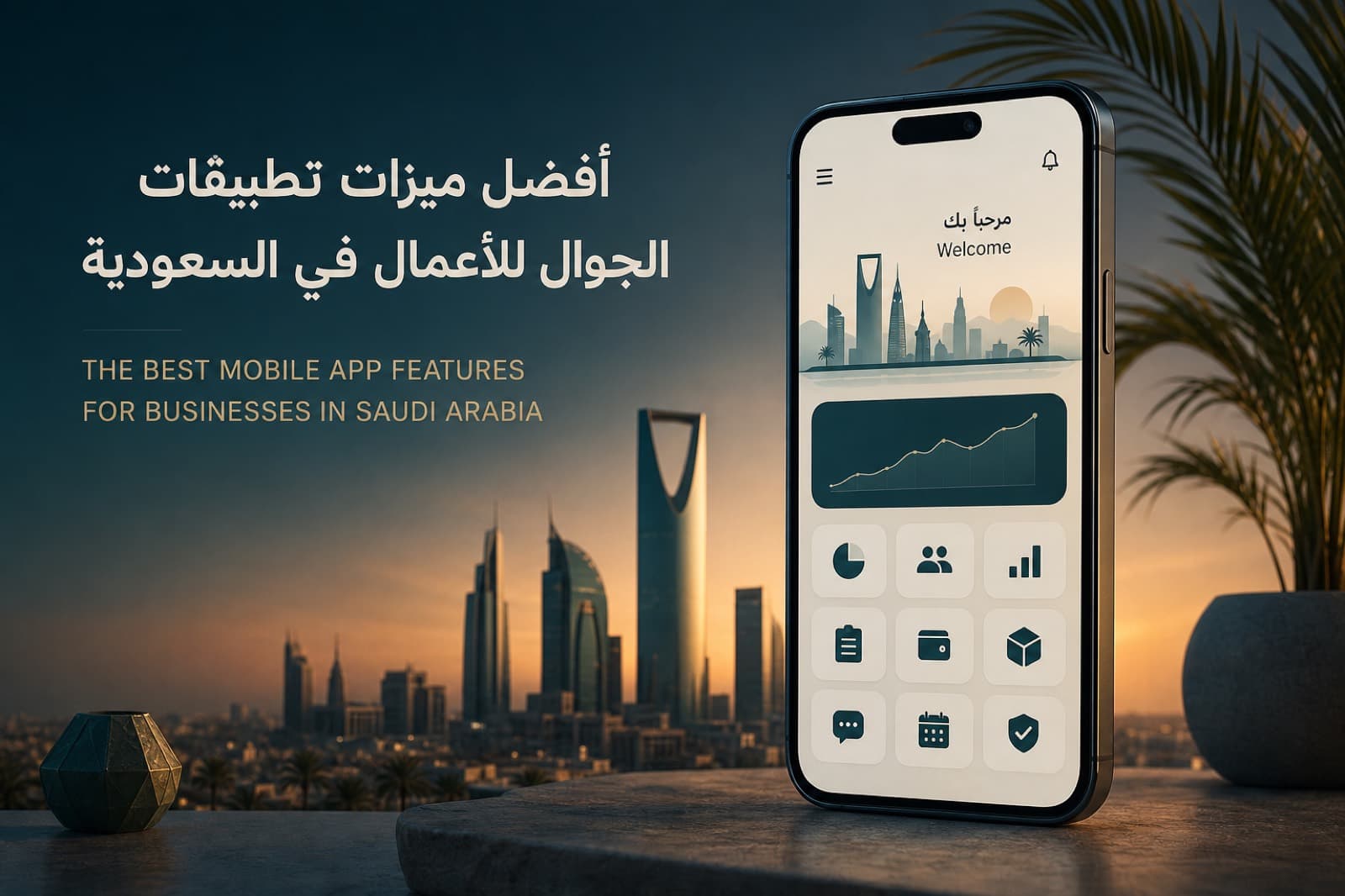
Best mobile app features for Saudi businesses — choose for outcomes
Feature selection is one of the most important decisions when you build a mobile app. The right mix improves engagement, retention, and revenue. The wrong mix burns budget on screens nobody uses.
Best mobile app features for Saudi businesses are not copied from a global super-app. They match how local customers register, pay, speak Arabic and English, and ask for help on WhatsApp.
I am Umer Farooq, a senior software engineer working with founders across Saudi Arabia, the UAE, Qatar, and Oman. This guide explains must-have features, industry picks, MVP priorities, and SAR cost posture — without invented testimonials or ranking promises.
Use it as a planning worksheet with your team. Agree on the business goal first — bookings, sales, loyalty, or operations — then pick features that serve that goal.
A short feature list with strong bilingual UX usually beats a long list with slow screens and unclear CTAs. Saudi users judge quality quickly on mid-range Android phones as well as flagships.
If you are a founder, product owner, or operations lead, treat this article as a workshop agenda. Walk section by section and mark each feature as now, next, or never for your first release.
Saudi digital behaviour mixes global app habits with local preferences for phone OTP, bilingual content, and fast support via WhatsApp. Feature choices that ignore those patterns look modern in Figma and weak in production.
1 job
MVP should complete one clear job
AR + EN
Plan bilingual when audiences need it
Phase 2
AI & loyalty after core works
Why mobile app features matter
Features shape trust. Smooth registration, clear prices, and secure checkout tell customers you are serious. Cluttered menus and broken notifications tell them to leave.
Features also shape cost and timeline. Every extra module needs design, engineering, QA, and later maintenance. That is why prioritisation matters as much as creativity.
For Saudi businesses, bilingual layouts, OTP habits, and delivery or booking expectations change which features are mandatory on day one versus phase two.
[Infographic: Essential Mobile App Features] — onboarding, core job (book/buy/track), support path, security basics, and admin control are the spine of most successful apps.
Features also affect reviews. One missing OTP recovery path or broken notification permission flow can tank ratings even when the rest of the design looks premium.
Think of features as hiring decisions. Each one needs care after launch. Prefer fewer features you can support well.
Must-have features for every business app
Regardless of industry, most Saudi business apps need identity, a clear home task, notifications with permission hygiene, a support path, and an admin way to update content without republishing the store binary.
If your MVP cannot complete one valuable user job end to end, more features will not save it.
Document your must-haves in writing before design freezes. Verbal wishlists expand weekly and destroy timelines.
Make someone own the backlog. When everyone can add features and nobody can remove them, MVPs stop being minimum.
- Account creation and recovery
- Clear primary CTA on home
- Arabic and English where audiences need both
- Push notifications with user control
- Basic analytics events
- Admin or CMS path for content and status
Essential vs advanced features
[Infographic: Essential Mobile App Features]
Swipe sideways to see all columns →
| Feature group | Essential MVP | Advanced / later |
|---|---|---|
| Identity | OTP / simple profile | Social graph, complex KYC |
| Core job | Book / buy / track | Marketplace tooling |
| Engagement | Useful pushes | Heavy gamification |
| Intelligence | Basic search | AI recommendations |
Customer experience features
Customer experience features decide whether first sessions become second sessions. Keep the path short and respectful of time.
Map the first five minutes after install. If a user cannot understand what to do on the home screen without a tutorial novel, simplify the information architecture before adding more modules.
User features vs admin features
Swipe sideways to see all columns →
| Need | Customer app | Admin / staff |
|---|---|---|
| Core job | Complete booking or purchase | Confirm, update, refund |
| Communication | Status and chat/WhatsApp | Tickets and templates |
| Personal data | Profile and preferences | Role-based access |
| Failure mode | Pretty UI, no result | No admin — WhatsApp chaos |
User profiles and personalized dashboards
Profiles store addresses, preferences, language, and history. Personalised dashboards surface the next useful action — open booking, unpaid invoice, last order, or course progress.
Do not over-personalise on day one with empty data. Show useful defaults, then earn personalisation with usage.
Engagement features
Engagement features keep the app useful between major purchases. Treat them carefully — spammy push destroys trust.
Engagement is a system, not a button. Content quality, timing, and relevance matter more than the number of channels you enable on day one.
Push notifications, in-app messaging, live chat, and loyalty
Push works for order updates, appointment reminders, and scarce useful promos. Segment by language when possible.
In-app messaging and live chat help support, but many Saudi users still prefer WhatsApp. A chat widget that hands off to WhatsApp can be more practical than a full agent suite on day one.
Loyalty and rewards raise retention when the core job already works. Points on a broken booking flow train users to ignore you.
Write notification copy for Arabic and English separately. Machine-translated promo spam is easy to spot and easy to mute.
Business features
Business features are where revenue happens. Match them to your model instead of installing every commerce module by default.
Write acceptance criteria for each revenue feature. For example, a booking is not done until reminders and cancellation rules work — not when the calendar UI looks pretty.
Booking systems, catalogues, carts, payments, and tracking
Booking and appointments fit clinics, salons, consultants, and classrooms. Product catalogues, carts, and secure payments fit retail. Order tracking fits anything with physical fulfilment.
Secure payments should sit with trusted gateways. Test failures and refunds. Never treat checkout as a visual-only task.
Practical example: a Jeddah retail brand may need catalogue and payments before loyalty. A clinic needs booking and reminders before a shop.
VAT-aware pricing display and clear fee breakdowns reduce support tickets. Surprise fees at the last payment screen damage trust.
AI-powered features
AI features can improve discovery and support after you have clean data. They should not delay a reliable MVP.
[AI Feature Comparison Chart] — recommendations need history; smart search needs catalogue metadata; chatbots need escalation paths.
AI features comparison
[AI Feature Comparison Chart]
Swipe sideways to see all columns →
| AI feature | Needs to work well | MVP advice |
|---|---|---|
| Chatbot | FAQ corpus + human handoff | Phase 2 for most SMEs |
| Recommendations | Clean tags + history | After repeat orders exist |
| Smart search | Good metadata | Useful when catalogue is large |
| Predictive analytics | Clean operational data | After stable volume |
AI chatbot, recommendations, voice search, smart search, and predictive analytics
AI chatbots answer FAQs after hours with human handover for refunds or medical questions. Personalized recommendations help when category tags and order history exist.
Voice search and smart search help large catalogues. Predictive analytics helps inventory and demand once your data is clean enough to trust.
Be honest: bad metadata produces bad suggestions. Fund catalogue quality before recommendation theatres.
For regulated verticals like healthcare, keep humans in the loop. Chatbots should never invent clinical advice.
Security features
Security features protect customers and your reputation. In Saudi markets, trust signals matter as much as colour themes.
Security work is easier to fund as a baseline than as an emergency after a public incident. Put it in the MVP budget where money or personal data is involved.
Two-factor authentication, biometrics, encryption, and secure payments
Two-factor authentication and OTP reduce account takeover. Biometric login improves return-visit speed on supported devices.
Data encryption in transit and careful secret handling are baseline. Secure payment processing belongs with certified providers — do not invent card capture screens.
Role-based admin access matters once more than one staff member can issue refunds.
Plan a breach response contact and admin audit logs before you launch paid features. Security is process as well as code.
Performance features
Performance is a feature. Slow apps feel untrustworthy even when branding is premium.
Set a performance budget: first interactive screen under a few seconds on a typical Saudi mobile network, not only on office Wi-Fi. Measure it before launch ads start.
Offline mode, fast loading, cloud sync, and real-time updates
Offline mode helps field teams and travellers with spotty connectivity — useful for logistics and inspections. Fast loading on mid-range Android devices matters more than desktop demos.
Cloud sync keeps carts, bookings, and profiles consistent. Real-time updates matter for tracking, chat, and inventory when delay creates support tickets.
Test on mid-range Android devices used by drivers and field staff. Flagship-only demos hide performance debt.
Industry-specific features
Industry features convert generic apps into useful products. Below are practical picks for common Saudi verticals.
[Feature Comparison by Industry] — start with the industry table in this article, then cut anything not needed for the first 90 days.
If your business spans two industries — for example clinic plus pharmacy retail — sequence the higher-margin job first. Dual-mode apps often need two MVPs sharing one design system.
Features by industry
Swipe sideways to see all columns →
| Industry | MVP focus | Delay if needed |
|---|---|---|
| Healthcare | Booking + reminders | Full patient portal |
| Restaurant | Menu + checkout + status | Own fleet tracking |
| eCommerce | Catalog + pay + refunds | Heavy loyalty / AI |
| Logistics | Roles + status + POD | Complex rating networks |
Healthcare apps
Healthcare apps need doctor or service profiles, booking, reminders, clear clinic info, and careful handling of sensitive data. Avoid overbuilding patient portals before schedules work.
Arabic medical wording needs careful review. Plan content early with clinicians.
Clarify what data you store and why. Transparent privacy messaging builds confidence with patients and clinic managers.
Restaurant apps
Restaurant apps need menus, modifiers, cart, payments, and order status. Driver tracking joins when you operate delivery yourself.
Menu CMS is essential if prices change often. A beautiful homepage with last month's menu damages trust.
Peak-hour simulation is mandatory QA. Twenty simultaneous orders will find every weak edge case.
eCommerce apps
eCommerce apps need catalogue depth, variants, search, checkout, and returns logic. Wishlist and loyalty can wait until paid orders are stable.
Returns and refunds are features, not afterthoughts. Design them with the same care as checkout.
Real estate apps
Real estate apps need listings, filters, enquiry forms, and agent contact. Map quality and fast photo loading matter more than 3D gimmicks on MVP.
Lead routing to the right agent matters as much as pretty listing cards. Unassigned leads kill ROI.
Logistics apps
Logistics apps need role separation for sender, driver, and admin; live status; proof of delivery; and clear failed-attempt rules.
Driver apps should work on mid-range phones with battery-aware location updates.
Proof of delivery and failed-attempt reasons reduce disputes between sender and recipient.
Education apps
Education apps need course lists, enrolment or enquiry CTAs, schedules, and progress views. Parent audiences on mobile expect obvious contact options.
Schedules and reminders retain students better than decorative animations.
Features that increase customer retention
Retention features work when the core value is already clear. Useful reminders, order history, saved preferences, loyal status with real benefits, and fast support beat flashy gamification.
Personalised home content based on real usage beats generic banners. Measure 7-day and 30-day return rates, not only installs.
Practical tip: one helpful notification type done well beats five promotional categories that users mute.
Ask customers why they returned — and why they did not. Feature roadmaps improve when support tickets inform them.
Common feature mistakes to avoid
Building a marketplace stack for a single-branch business. Adding AI chat before OTP and payments work. Ignoring Arabic RTL. Shipping without an admin path. Copying a competitor entire feature list into MVP.
Another mistake is measuring success as number of features shipped. Measure completed jobs — bookings made, orders paid, tickets resolved.
Also avoid locking all content in the app binary. If marketing needs a developer for every price change, operating cost silently exceeds build cost.
Do not confuse competitor screenshots with requirements. Copying three apps at once creates a Frankenstein product that is expensive to build and confusing to use.
Finally, avoid launching paid acquisition the same week as a brand-new checkout. Soft launch with staff and loyal customers first so you find failures privately.
How to prioritize features for an MVP
Start with one primary user job. List must-have steps to complete it. Move everything else to phase two with dates, not forever maybes.
[Feature Priority Matrix] — impact vs effort. Ship high-impact, lower-effort items first. Delay low-impact, high-effort ideas even if they look impressive in demos.
Include Arabic language decision explicitly. Retrofitting RTL late is more expensive than designing it early when your audience needs it.
Invite operations staff into prioritisation meetings. Marketing alone will overfund engagement and underfund fulfilment.
Feature priority matrix
[Feature Priority Matrix] — impact vs effort guidance
Swipe sideways to see all columns →
| Priority | Examples | Action |
|---|---|---|
| P0 must ship | Auth, core job, status | Build now |
| P1 soon | Payments polish, bilingual QA | Next sprint block |
| P2 later | Loyalty, referrals | After retention baseline |
| Park | Voice experiments, AR | Revisit with data |
Mobile app feature planner and business goals selector
If the goal is leads, prioritise profiles, forms, WhatsApp handoff, and tracking of enquiries. If the goal is transactions, prioritise catalogue or booking, payments, and status.
If the goal is operations, prioritise roles, offline capability, and admin dashboards. Do not fund loyalty before the core job is reliable.
[Customer Journey Flowchart] — awareness → install → first success → return visit → referral. Features should unblock each stage.
Create a one-page matrix: business goal, user moment, feature, success metric. If a feature cannot fill those four fields, it is not ready for estimation.
Example: goal = more repeat salon visits; moment = day before appointment; feature = reminder push + easy reschedule; metric = no-show rate. That is a fundable feature story.
Feature ROI estimator — budget impact
Mobile app planning worksheet
- Business goal for 90 days
- Primary user and language
- Must-have features list (max 8)
- Explicit phase-two list
- Success metric (bookings, orders, retention)
- Owner of store accounts and cloud billing
Feature development cost overview
Costs vary by complexity and bilingual depth. Directional SAR planning signals for professional work in 2026:
Ask vendors for line-item proposals by feature group. Bundle quotes hide whether bilingual QA and admin tools are included.
Remember these are directional bands for full apps with meaningful feature sets — not prices for a single button. Always map features to roles and integrations before trusting a low quote.
Hidden cost drivers include Arabic copy production, SMS OTP fees, map usage, payment merchant fees, and post-launch maintenance hours.
- Core MVP feature set (auth, home job, basic admin) — often part of a SAR 7,500–30,000 app band depending on scope
- Payments + order/booking flows — meaningful uplift over brochure apps
- Live tracking / multi-role logistics — among the highest cost drivers
- AI recommendations / advanced personalisation — usually phase two spend
Feature complexity vs planning cost posture (SAR app bands)
Directional — full app scope depends on how many groups you combine
Brochure + auth MVP
6–10 weeks
SAR 55,000 – 120,000
Booking / light commerce
8–14 weeks
SAR 90,000 – 200,000
Full commerce + tracking
3–6 months
SAR 140,000 – 380,000
Multi-role platform
5–9+ months
SAR 180,000 – 450,000
Who should build your feature roadmap
Freelancer
Lower day rate
Best for: Tiny MVP scope
Watch for: Security and continuity
Agency
Higher packages
Best for: Multi-stakeholder brands
Watch for: Who codes day to day
Senior independent
Mid–premium, direct
Best for: Focused SME apps
Watch for: Capacity — milestones
Estimated development time by feature group
Time depends on design readiness and integrations. Rough planning windows after decisions are locked:
Auth and profiles may take days to a couple of weeks. Catalogues and booking engines take longer. Payments and logistics tracking often dominate calendars because of edge cases.
[Development Roadmap Timeline] — discovery → MVP core → revenue features → engagement → advanced AI.
Buffer calendar time for store reviews and content delays. Engineering may be ready while Arabic product photos and legal pages are not.
A practical sequencing tip: freeze design for P0 screens before starting advanced animations or experimental modules. Parallel chaos creates rework.
[Development Roadmap Timeline] — relative effort index
20
Auth/profile
55
Core booking/buy
45
Payments
80
Tracking/multi-role
50
AI extras
Future mobile app trends in Saudi Arabia
Expect continued demand for bilingual UX, wallet-friendly payments, faster delivery promises, and tighter ops tooling. Super-app envy will remain common — resist it unless you have the team to operate it.
On-device biometrics, better personalisation with privacy discipline, and richer admin automation will matter more than random visual trends.
The durable trend is usefulness. Apps that complete local jobs reliably keep users.
Accessibility and inclusive design will matter more as digital services expand. Tap targets, contrast, and readable Arabic typography are competitive advantages.
MVP feature checklist and launch readiness
Before development starts, lock the checklist of must-haves. Before store submission, lock launch readiness.
Print the checklists from this article and bring them to vendor interviews. Comparable answers make feature delivery promises easier to judge.
- Primary user job defined in one sentence
- Languages decided with RTL plan
- Auth path tested on real devices
- Core booking/buy/track flow completes
- Payment failure path tested if money moves
- Support/WhatsApp path works
- Analytics events firing
- Crash reporting enabled
MVP feature checklist
- One-sentence primary user job
- Auth and recovery path
- Core booking/buy/track complete
- Arabic / English decision documented
- Support or WhatsApp handoff
- Basic admin updates without resubmitting stores
Launch readiness checklist
- Real-device QA on mid-range Android + iOS
- Payment failure paths tested if money moves
- Push permission copy reviewed
- Analytics events and crash reporting live
- Privacy text and store listings ready
- Rollback owner named for bad builds
WhatsApp, OTPs, and local UX expectations
Many Saudi customers still prefer WhatsApp for support even when the app has in-app chat. Design a clear handoff instead of fighting the habit blindly.
OTP login is familiar. Make recovery paths obvious when numbers change. Failed OTP loops are a top early-churn cause for new apps.
Arabic typography, RTL alignment, and correctly mirrored icons are quality features. Users notice when Arabic looks like an afterthought pasted into an English layout.
Test forms with long Arabic names and mixed bilingual addresses. Layout bugs appear there before they appear in English demos.
Local trust also means clear business identity in the app: location, contact path, and consistent branding with your website. Confusion between channels reduces conversion.
Feature ROI thinking for Saudi teams
ROI is easier to judge when each feature has a metric. Booking reminders should reduce no-shows. Checkout improvements should raise paid conversion. Support chat should reduce unanswered WhatsApp threads — or at least route them faster.
Avoid vanity ROI claims. A feature that looks popular in analytics but does not change revenue, cost, or retention is optional decoration.
Practical method: estimate monthly value from one avoided support hour, one recovered abandoned checkout, or one retained subscription. Compare that to build plus maintenance cost over six months.
Saudi businesses with thin teams should bias toward features that reduce manual coordination — shared order status, automated reminders, and clear admin queues often beat exotic engagement widgets.
Admin features that protect growth
Customer apps get attention, but admin features protect margins. Status updates, refund controls, catalogue editing, role permissions, and basic reports keep operations calm when volume rises.
If staff cannot update product availability without a developer, you will sell out-of-stock items and create refunds during campaigns.
Give support a timeline view of each order or booking. When customers call, agents should answer in seconds, not by searching chat history.
Start with weekly-used admin screens. Fancy BI dashboards can wait until you have enough events to learn from.
Building a phased feature roadmap
A clean roadmap for many Saudi SMEs looks like this: Phase 1 completes the primary job with bilingual UX and basic admin. Phase 2 hardens payments, notifications, and support. Phase 3 adds loyalty or recommendations with data.
Publish the roadmap internally so marketing campaigns do not promise phase-three features during phase-one soft launch.
Review the roadmap monthly against support tickets and analytics. Real usage should reorder the backlog more often than competitor envy.
Keep a parking lot of ideas. Parking is not rejection. It is prioritisation with honesty.
Share the roadmap with customer support weekly. Their ticket themes are often the fastest signal for which feature deserves to move up.
FAQ — best mobile app features for Saudi businesses
What are the best mobile app features for Saudi businesses? Start with bilingual onboarding, a clear primary job, secure payments or booking if needed, useful notifications, support handoff, and admin controls. Add AI and loyalty after the core path works.
Which features belong in an MVP? Only the steps required to complete one valuable job end to end. Everything else is phase two.
Do Saudi apps need Arabic from day one? If your customers use Arabic, yes — or schedule RTL as a near-term phase with a date.
Are AI features required? No. They help later when data is clean. Do not delay payments and fulfilment for chatbot demos.
What features raise retention most? Reliable core value, helpful reminders, history, preferences, real rewards, and fast support.
How do features affect cost? Each module adds design, engineering, QA, and maintenance. Live tracking and multi-role systems usually cost more than profile screens.
Should every business app include ecommerce? Only if you sell products. Service businesses often need booking and CRM more than carts.
How do I choose a development partner? Ask for bilingual samples, milestone demos, and clear ownership of code and store accounts.
Should we build native or Flutter for feature-heavy apps? For most Saudi SME MVPs, Flutter or React Native covers feature needs well when the API is solid. Choose native when you have separate platform teams or rare OS-level requirements.
How many features is too many for launch? If the team cannot demo the full happy path in under three minutes, the MVP is probably overloaded.
Conclusion — pick features that earn their keep
Best mobile app features for Saudi businesses are the ones that complete customer jobs and protect trust. Use the tables and checklists in this guide to cut vanity scope and fund what matters.
If you want help choosing and building features for a Saudi mobile app — including Flutter, iOS, Android, ecommerce, or AI-assisted modules — request a quote or book a free consultation. Bring your primary user job and 90-day goal; you will get a clearer plan than a generic feature checklist package.
Explore the portfolio for shipped patterns, read related guides on the blog, and start with an MVP you can launch and measure — then grow with evidence.
When you are ready, share a one-page brief with your primary user job, languages, and must-have features. That single document turns a vague feature wishlist into a buildable Saudi app plan.
Strong feature choices are a growth advantage. Build what your customers will use next week — not what looks impressive in a pitch deck.
If you want a second pair of eyes on your feature list, bring it to a free consultation. We can mark each item as MVP, phase two, or cut — with a realistic SAR delivery posture.
Good features earn their place. Start there.
Measure completed jobs, not feature count — then expand with confidence.
That discipline is how Saudi apps stay useful long after launch day.