Website Development
Website Development Cost in Muscat
Website development cost in Muscat (2026): OMR ranges by site type, WordPress vs Next.js, timelines, hidden fees, and a free calculator for Oman businesses.
2026-08-04 · 24 min read
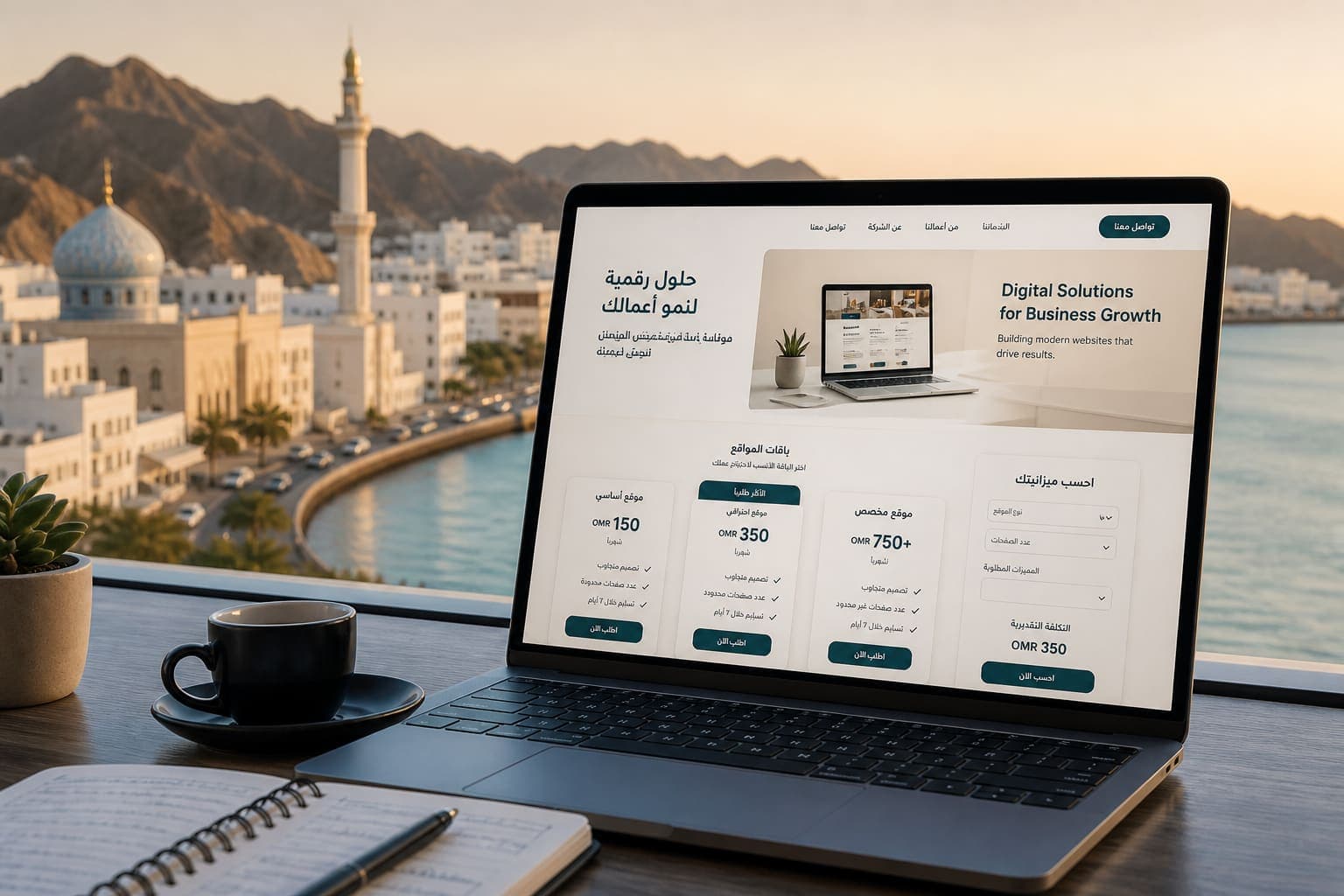
Website Cost Calculator (Muscat)
Pick website type, technology approach, and complexity for a directional OMR range — then validate with a real page list.
Directional estimate
OMR 271 – 468
Planning range only — not a fixed quote. Integrations, Arabic RTL, and content readiness can move the number. Request a scoped estimate.
Website development cost in Muscat — quick answer for 2026
Website development cost in Muscat usually falls between about OMR 250 and OMR 2,800 for landing pages and solid small-business sites, while bilingual corporate builds and ecommerce storefronts often land between OMR 2,500 and OMR 12,000+. Custom portals and multi-language enterprise sites go higher.
The number moves with page count, Arabic/English depth, design polish, CMS needs, and integrations — payments, booking, CRM, or inventory. A pretty five-page brochure and a sales system that books appointments are not the same project.
This guide explains average ranges, cost by type and technology, hidden fees, maintenance, timelines, and how to brief a web development company Muscat businesses can trust.
OMR 250–900
Landing / simple
OMR 900–2.8k
Small business site
3–6 wks
Typical focused build
What actually drives website cost?
You are mostly buying skilled time: discovery, UI/UX design Muscat teams (or remote partners), frontend build, CMS setup, content structuring, testing, and launch support.
Bilingual responsive website design Oman projects take more care than English-only templates. RTL layout, translated fields, and proofreading are real work — not a checkbox.
Key takeaway: write the job of the site (leads, sales, bookings, or credibility) before you ask for a quote.
Average website development cost in Muscat
For 2026 planning, use these directional OMR bands for professional website development Muscat work — not fixed package promises:
- Landing page / campaign site: roughly OMR 250–900 (about USD 650–2,300)
- Small business website Muscat (5–10 pages): roughly OMR 900–2,800 (about USD 2,300–7,300)
- Corporate website Muscat (bilingual, stronger design): roughly OMR 2,500–7,000
- eCommerce website development Muscat: roughly OMR 3,000–12,000+ depending on catalogue and payments
- Custom website development Oman / portals: often OMR 7,000–25,000+ in phases
Website type vs estimated cost (OMR)
Directional 2026 planning bands
Landing page
1–3 weeks
OMR 250 – 900
Small business
3–6 weeks
OMR 900 – 2,800
Corporate bilingual
5–10 weeks
OMR 2,500 – 7,000
eCommerce
6–14 weeks
OMR 3,000 – 12,000
Website cost calculator for Muscat
Estimate your band early. Use the calculator for a directional OMR range, then refine with the tables and checklists below.
Adjust website type, technology approach, and complexity. Treat the output as planning guidance — then validate with a page list and content readiness.
Website cost by business type
Business type changes content volume, trust signals, and integrations. A solo consultant site is not a hotel booking site.
Website type vs estimated cost
Planning guide for Muscat / Oman SMEs
Swipe sideways to see all columns →
| Site type | Typical OMR band | Primary goal |
|---|---|---|
| Landing page | 250–900 | Campaign conversion |
| Small business | 900–2,800 | Leads & trust |
| Corporate bilingual | 2,500–7,000 | Brand & enquiries |
| eCommerce | 3,000–12,000+ | Online sales |
| Portfolio | 400–1,500 | Proof & contact |
| Portal / custom | 7,000–25,000+ | Logged-in workflows |
Restaurant websites
Menus, location, hours, WhatsApp/CTAs, and optional online ordering or reservations. Photogenic food and clear delivery zones matter more than heavy animation.
Key takeaway: publish an up-to-date menu PDF or CMS menu before arguing about parallax effects.
Healthcare and clinic websites
Services, doctor profiles, booking or enquiry forms, and clear privacy messaging. Avoid medical claims you cannot stand behind.
Key takeaway: make booking or enquiry the primary action above the fold.
Law firm and professional services
Practice areas, team bios, case/process explainers, and strong contact paths. Credibility design beats gimmicks.
Real estate websites
Listings, filters, agent contact, and lead capture. Budget rises when you need gated inventories and frequent updates from many agents.
School and education sites
Programmes, admissions CTAs, calendars, and news. Parents need clarity more than novelty.
Hotel and travel websites
Room/tour catalogues, galleries, and booking or enquiry flows. Direct booking tools and channel integrations raise cost.
Website cost by features
Features are the cleanest budgeting language. Each integration and custom template has a price in hours.
Features vs relative effort
Use effort language with your vendor
Swipe sideways to see all columns →
| Feature | Relative effort | Budget note |
|---|---|---|
| 5–8 content pages | Low–medium | Core of most SME sites |
| Blog / news CMS | Low–medium | Great for SEO cadence |
| Arabic + English RTL | Medium | Budget early |
| Booking form / calendar | Medium | Integrations vary |
| Payments / checkout | High | eCommerce territory |
| Multi-location pages | Medium | Template reuse helps |
| Member login area | High | Custom/portal band |
| Animations / 3D | Medium–high | Easy to overspend |
Website cost by industry
Regulated or high-trust industries need careful copy and forms. High-SKU retail needs catalogue tooling. Lead-gen services need speed and SEO foundations.
Key takeaway: industry sets content and compliance posture more than it sets a magical multiplier.
Website cost by technology
WordPress development Muscat projects can be efficient for content-led sites when hosting is solid. Next.js development Oman and React website development Oman suit performance-critical marketing sites and custom experiences.
Traditional CMS platforms help editors. Custom stacks help unique UX and integrations. Pick for the next two years of editing reality — not a trend chart.
Technology comparison
WordPress vs Next.js vs React vs traditional CMS
Swipe sideways to see all columns →
| Stack | Strength | Best fit |
|---|---|---|
| WordPress | Editor-friendly CMS | Content-led SME sites |
| Next.js | Speed + SEO control | Marketing & headless |
| React custom | Interactive UI | Productised web apps |
| Traditional CMS | Familiar editing | Teams that live in CMS |
Website design vs website development
Design decides structure, visuals, and interaction. Development makes it real in browsers, CMS, and deployments. Paying for one without the other creates either a pretty picture that cannot launch or a stiff site nobody trusts.
Key takeaway: budget both — skimping on UI/UX design Muscat work often shows up as weak conversion later.
Static vs dynamic website
Static sites are fast and simple when content rarely changes. Dynamic CMS website Oman builds let your team update pages, blogs, and products without calling a developer every time.
Most growing SMEs need at least a lightweight CMS for blogs and service pages.
WordPress vs custom website
WordPress wins when content publishing and plugin ecosystems matter and you accept hosting/plugin maintenance discipline. Custom builds win when UX and integrations escape themes cleanly.
A web design company Oman should explain trade-offs in plain language — not only push the stack they already staffed.
CMS / approach comparison
Trade speed-to-launch against long-term fit
Swipe sideways to see all columns →
| Topic | WordPress | Custom / Next.js |
|---|---|---|
| Time to MVP | Often faster | Depends on scope |
| Editing ease | Strong with training | Depends on CMS choice |
| Unique UX | Theme limits possible | High ceiling |
| Maintenance | Plugins + hosting care | Dependencies + hosting |
Next.js vs React vs traditional CMS
Next.js shines for fast, SEO-friendly marketing sites and headless setups. React powers interactive UI but still needs a content and routing story. Traditional CMS keeps editing familiar for marketing teams.
Key takeaway: choose the lightest stack that hits performance, editing, and integration goals.
eCommerce website development cost
Storefronts add catalogue, cart, checkout, payments, tax/shipping rules, and order email flows. That is why ecommerce sits above brochure pricing.
Start with core SKUs and clear delivery rules inside Oman. Expand marketplace fantasies later.
Corporate website pricing
Corporate site cost rises with bilingual pages, stakeholder reviews, brand systems, careers pages, and accessibility expectations. Multiple approval rounds are a schedule risk — and therefore a cost risk.
Landing page cost
A single high-intent landing page can be lean if copy and creative are ready. Cost jumps when you need many variants, complex forms, or deep CMS integration.
Portfolio website cost
Portfolios and personal brands can stay near the lower band if case studies are prepared. Fancy case-study animations are optional; clear outcomes are not.
Freelancer vs web development agency
Freelancers can deliver focused sites when communication is strong. Agencies or small senior teams help when you need strategy, design, build, QA, and SEO foundations together.
Ask mobile app developers — wait, ask web partners — for live URLs, bilingual samples, and maintenance terms. Prior shipped work beats moodboards alone.
Freelancer vs agency (directional)
Freelancer
Lower entry
Best for: Simple sites, clear brief
Watch for: Single point of failure
Small senior team
Mid blended
Best for: Design + build + CMS
Watch for: Confirm QA ownership
Agency
Higher structured
Best for: Brand & ecommerce risk
Watch for: Demand named team
Freelancer vs agency comparison
Swipe sideways to see all columns →
| Topic | Freelancer | Agency / senior team |
|---|---|---|
| Cost | Can be lower | Higher, more bundled |
| Coverage | Often one skill | Strategy to QA |
| Continuity | Person-dependent | Process-dependent |
| Best use | Brochure / landing | Corporate / ecommerce |
Website maintenance costs
Website maintenance Oman retainers cover updates, backups, uptime checks, and small content help. Budget monthly care after launch — sites that freeze eventually break or get hacked.
Light care might be tens to low hundreds of OMR per month depending on complexity and response expectations.
Website maintenance cost (directional OMR / month)
Swipe sideways to see all columns →
| Care level | Monthly OMR | Includes |
|---|---|---|
| Light care | 40–120 | Updates, backups |
| Active marketing site | 120–350 | Fixes + small content help |
| Store / critical site | 350+ | Faster response, monitoring |
Domain and hosting costs
Domain names are usually modest yearly fees. Website hosting Oman quality matters more than saving OMR 2 on an overloaded shared plan that makes pages crawl.
Managed WordPress hosting or solid Vercel/cloud setups cost more than bargain basement hosting — and usually waste less staff time.
Hosting cost comparison (directional)
Pay for reliability — downtime is also a cost
Swipe sideways to see all columns →
| Hosting type | Fit | Notes |
|---|---|---|
| Cheap shared | Tiny brochure only | Risk of slowdowns |
| Managed WordPress | WP business sites | Easier updates |
| Cloud / Vercel-style | Next.js / JAMstack | Scales with traffic |
| VPS unmanaged | Technical teams | You own the ops |
SEO cost for websites
Technical SEO foundations (speed, metadata, sitemap, clean structure) should be part of a professional build. Ongoing SEO retainers for content and authority are separate from development.
Key takeaway: do not pay for rankings promises; pay for measurable work and clear reporting.
Website development timeline
A focused business site often takes 3–6 weeks after content is ready. Bilingual corporate and ecommerce usually need longer. Content delays are the quiet killers of calendars.
Website budget breakdown (illustrative)
Planning 10% · Design 20% · Development 40% · Testing 10% · SEO foundations 10% · Launch care 10%
Planning
10%
Design
20%
Development
40%
Testing
10%
SEO foundations
10%
Launch & early care
10%
Website timeline — relative weeks (focused SME site)
Week 1 research · Week 2 wireframes · Weeks 3–6 build · Week 7 testing · Week 8 launch
1
Research
1
Wireframes
4
Build
1
QA
1
Launch
Website timeline by type
Assumes content is moving in parallel
Swipe sideways to see all columns →
| Project | Typical duration | Watch-out |
|---|---|---|
| Landing page | 1–3 weeks | Copy delays |
| Small business site | 3–6 weeks | Asset gathering |
| Corporate bilingual | 5–10 weeks | Approvals |
| eCommerce | 6–14 weeks | Catalogue + payments |
Factors affecting website cost
Page count, bilingual depth, custom design vs theme, integrations, animation level, accessibility ambition, and how many stakeholders must approve every pixel.
What moves quotes up or down
How to reduce website development costs
Reuse components. Start with must-have pages. Provide copy and photos early. Prefer proven CMS patterns unless you truly need custom. Freeze scope during build sprints.
Key takeaway: clarity is a discount you control.
Common mistakes businesses make
Buying a theme and calling it strategy. Skipping mobile checks. Hiding contact details. Launching without analytics. Changing the brief every other day.
Website redesign Oman projects fail when nobody defined what was wrong with the old site in metrics — only in opinions.
How to choose the right web development company
Look for discovery questions, clear milestones, staging demos, bilingual craft, and maintenance options. A web development company Muscat or regional partner should talk about leads and clarity — not only fonts.
Decision tree — which budget band fits?
Need one campaign page with a form? Landing band. Need trust pages and services for a small business? Business band. Need brand polish and Arabic/English? Corporate band. Need to sell products online? eCommerce band. Need custom workflows? Custom/portal band.
Realistic pricing examples by site type
These are planning scenarios — not guarantees.
Restaurant: menu + location + WhatsApp CTA — often upper landing to lower business band.
Clinic: services + booking enquiry — business band if bilingual.
Law firm: practice areas + team — business to corporate band with stronger design.
Real estate: listings tools push toward custom or specialised templates.
Hotel/travel: galleries + enquiry/booking integrations raise cost.
eCommerce store: catalogue + payments — ecommerce band.
Corporate: bilingual multi-page — corporate band.
Portfolio: lower band if content is ready.
Did you know? — Muscat buyer habits
Many customers still message on WhatsApp after browsing. Your site should make that path obvious — and still capture context (which service they viewed) when possible.
Slow mobile pages lose people who are comparing two vendors on the same sofa. Speed is a sales feature.
Expert tips and common traps
Expert tip: approve sitemap and wireframes before high-fidelity visuals for every page.
Common mistake: starting visual design while the offer and page list are still changing.
Best practice: one conversion goal per primary template.
Pro advice: measure enquiries for 30 days before a total redesign.
Before hiring a web development company checklist
Use this before you sign. Gaps become change requests.
Before hiring a web development company
- Primary conversion goal written in one sentence
- Draft page list (5–15 pages typical for SME)
- Arabic/English decision documented
- Examples of sites you like (and why)
- Logo, colours, and photo availability checked
- Integrations listed (WhatsApp, forms, payments)
- Budget band and deadline shared honestly
- Who approves designs named
- Maintenance expectation after launch
- Domain and hosting ownership clarified
Website budget planning checklist
Separate build, first-year maintenance, hosting, and content production.
Website budget planning checklist
- Build band selected (landing / business / corporate / ecommerce)
- Content writing budget reserved
- Photography / media budget reserved
- First-year maintenance reserved
- Hosting and domain fees reserved
- Contingency 10–15% for discoveries
- SEO foundations included in scope language
- Revision rounds defined in writing
Website launch checklist
Forms tested, analytics live, redirects mapped, favicons, 404 page, WhatsApp/click-to-call checked on real phones.
Website launch checklist
- Forms tested on mobile
- Analytics and search console connected
- Redirects for old URLs mapped
- Favicon, titles, and meta descriptions set
- 404 and thank-you pages checked
- WhatsApp / click-to-call verified
- Arabic pages reviewed by a human
- Backup and SSL confirmed
Website maintenance checklist
Updates, backups, uptime, SSL, broken-link checks, and monthly content hygiene.
Website maintenance checklist
- CMS and plugin/dependency updates
- Weekly or monthly backup verification
- Uptime monitoring alerts
- Broken link and form spot checks
- Security patches applied promptly
- Content accuracy review (hours, prices, offers)
- Performance check on mid-range phones
- SSL renewal monitoring
Mini quiz — are you ready to buy a website?
Can you list your top 5–10 pages? Do you have logos and photos? Who writes Arabic copy? Who updates the site monthly? What is the primary conversion action?
Four or five yes answers: you can brief well. Two or fewer: prepare assets first to avoid paying for idle sprint time.
Key takeaway: readiness lowers website development cost in Muscat more than haggling alone.
Discovery and process — how good projects run
A healthy process looks like: discovery → planning → UI/UX → development → testing → deployment → maintenance. Skipping discovery to save a week often spends three weeks later.
Key takeaway: ask vendors to show their process against your calendar — not only a price cell in a spreadsheet.
Content readiness — the silent budget dial
Developers cannot invent your services, prices, and proof. Late content stalls QA and SEO. Assign a content owner on day one.
Key takeaway: content late is the most common reason timelines slip in Muscat SME projects.
Accessibility and trust signals
Readable type, contrast, clear focus states, and honest contact details help real users — including customers on bright outdoor screens.
Show location, hours where relevant, and real photos when you can. Trust is conversion.
Integrations that commonly add cost
Payment gateways, booking engines, CRM forms, live chat, newsletter tools, multi-language switchers, and membership areas. Each needs configuration and testing.
When to redesign vs fix what you have
Redesign when the structure cannot support your offer or mobile experience is broken. Fix when the issue is speed, copy, or a weak CTA on an otherwise sound structure.
Key takeaway: diagnose with analytics and five user sessions before funding a full rebuild.
How to read a website proposal
Check page list, languages, revisions included, what “SEO” means in the quote, hosting responsibility, training, and warranty. Compare exclusions line by line.
Questions to ask before you pay a deposit
Who is the day-to-day contact? How many design rounds? Who uploads content? What is out of scope? Who owns the codebase and domain DNS access?
Build now vs wait
Build now if you are paying for ads into weak pages, losing trust on mobile, or cannot update key info without a developer. Wait if you cannot describe services clearly yet — clarify the offer first.
External references worth using
For performance and SEO technical baselines, use official documentation from Google Search Central and core web documentation from MDN. Hosting and CMS vendors publish their own requirements — trust those over rumour chains.
For business licensing or sector rules that affect public claims on your site, rely on official Omani government sources and qualified advisors — not anonymous forum posts.
Putting numbers into a one-page brief
Write: goal of the site, audiences, page list, languages, integrations, examples you like, budget band, and go-live constraints. Attach logos and sample copy.
With that brief, website development cost in Muscat quotes become comparable across freelancers and agencies.
Email deliverability and domain setup
A contact form that sends to a free inbox with no domain authentication can land in spam. Set up proper DNS records for business email when you launch the site.
Thank-you emails and enquiry notifications should be tested with real mailboxes used by your sales team — including mobile mail apps.
Key takeaway: deliverability is part of “the website works,” even when it lives outside the homepage design file.
Seasonal campaigns without rebuilding the site
Plan a homepage banner slot and a reusable landing template for Ramadan, National Day, or back-to-school offers. That reduces panic redesigns every season.
Document how marketing can swap hero images and offers safely without breaking mobile layout.
Key takeaway: a little CMS structure up front saves repeated emergency fees later.
Internal linking and blog foundations
If content marketing is part of growth, launch with a blog template and category structure — even if you only publish twice a month at first.
Link service pages to helpful guides. Readers who understand the problem convert with less pressure from sales.
Key takeaway: structure for content early if SEO is a year-one channel — bolting it on later is messier.
Comparing quotes fairly in Oman
Normalize every proposal to the same page list, languages, revision rounds, and maintenance month. A “cheap” quote that omits bilingual layout is not cheaper — it is incomplete.
Ask each vendor to price the same optional add-ons separately: blog, booking, ecommerce starter, and express timeline.
Key takeaway: comparable scopes produce comparable prices; emotional presentations do not.
What “responsive” really means for Muscat users
Responsive website design Oman work means layouts adapt cleanly across phones, tablets, and desktops — not only that the site “opens” on mobile.
Check sticky CTAs, font sizes, and form fields with one thumb. If users need to pinch-zoom to tap Call, you are leaving enquiries on the table.
Key takeaway: test on a mid-range Android device before you approve the build — many customers do not browse on a designer's laptop.
When custom website development Oman is worth it
Choose custom when your booking rules, pricing logic, or customer portal cannot fit a theme without fighting it weekly. Also choose custom when brand experience is a competitive advantage you will reuse across campaigns.
Do not choose custom only because a competitor's site looks expensive. Look at your operations and editing staffing first.
Key takeaway: custom should reduce long-term friction, not maximise invoice size.
Performance budgets — why speed is a line item
A fast site is not a luxury graphic setting. It affects bounce rate, ad quality scores, and whether a customer waits for your menu to load while sitting in traffic in Qurum.
Performance work includes image compression discipline, clean code, careful plugins, and hosting that is not overloaded. Cheap themes stuffed with unused builders can tax every visit.
Agree a simple performance goal: for example, a usable mobile homepage within a few seconds on mid-range Android. Then test before launch — not after you spend on ads.
Key takeaway: speed is part of website design Muscat buyers feel immediately, even when they cannot name Core Web Vitals.
Forms, CRM, and lead handling
Beautiful pages that email nobody do not create revenue. Forms need routing: email notifications, CRM fields, or WhatsApp handoffs with enough context that sales is not guessing.
Spam protection and thank-you pages matter. So does response time. A lead that waits a day often buys elsewhere.
Key takeaway: define who answers enquiries during business hours before you celebrate launch day.
Brand systems vs one-off page decoration
A simple design system — type scale, buttons, spacing, cards — keeps pages consistent and cheaper to extend. One-off decorations on every page look busy and raise the cost of every future landing page.
Corporate website Muscat projects benefit especially from systems thinking because many stakeholders will request “just one more page” after launch.
Key takeaway: invest once in components; stop reinventing buttons in every Figma file.
Analytics setup that answers real questions
Install analytics with goals: form submits, click-to-call, WhatsApp taps, and key service page views. Vanity traffic charts without goals create false confidence.
Share a simple monthly readout: top pages, top enquiry sources, and devices. Then decide whether to improve content or ads — not both blindly.
Key takeaway: measurement is how you avoid paying twice for the same guess.
Security basics for SME websites
Use HTTPS, strong admin passwords, limited admin accounts, and timely updates. For WordPress, remove unused plugins and lock down login endings where appropriate.
Backups are useless if nobody ever tested a restore. Schedule a restore drill once after launch.
Key takeaway: security maintenance is cheaper than emergency rebuilds after a defacement.
Muscat SME walkthrough — service business
A cleaning company wants more WhatsApp enquiries. A sharp five-to-seven page site with services, areas covered, proof photos, pricing guidance, and sticky WhatsApp can outperform a 30-page brochure nobody updates.
Budget posture: small business band with strong mobile CTAs. Skip membership portals until repeat contracts need them.
Key takeaway: match page count to sales conversations you already win offline.
Muscat SME walkthrough — retailer going online
A boutique selling through Instagram wants ecommerce. Start with bestselling SKUs, clear size guides, delivery fees inside Oman, and reliable checkout. Do not migrate every dead SKU on day one.
Budget posture: ecommerce band; keep custom AR try-ons out of version one.
Key takeaway: catalogue hygiene is half the project — photography and descriptions included.
Stakeholder management without blowing the budget
Too many approvers create circular feedback. Appoint one product owner. Collect feedback in rounds with deadlines. “Open feedback forever” is how timelines dissolve.
Show wireframes to decision-makers early so disagreements happen before visual polish.
Key takeaway: governance is a cost-control tool in family businesses and multi-department brands alike.
Theme builders vs handcrafted templates
Builders can speed simple launches. They can also create heavy pages and lock-in. Handcrafted templates cost more upfront and often cost less in long-term performance drama.
Choose based on who will edit the site monthly. If non-technical staff must change layouts constantly, builder ecosystems may fit. If marketing wants speed and brand fidelity, leaner custom templates often win.
Key takeaway: editing reality beats demo-day wow.
Migration and redesign special costs
Website redesign Oman work includes redirects, content migration, and message consistency. Skipping redirects throws away search equity and breaks old links shared on Instagram bios.
Audit top landing pages before migration. Bring the winners forward first.
Key takeaway: migration is a project — line-item it.
Local SEO pages without spam
Service-area pages can help if they contain genuine differences — areas served, travel notes, photos — not duplicated paragraphs with the city name swapped.
Google’s own guidance prefers helpful unique content. Thin doorway pages waste money and risk trust.
Key takeaway: write for humans in Muscat neighbourhoods you truly serve.
Photography and media production budgets
Generic stock photos of unrelated skylines weaken local trust. Real premises, team, and product photos usually convert better.
Budget a shoot or a structured photo collection day. Editing and compression are part of responsive website design Oman quality.
Key takeaway: media is a marketing asset — not an afterthought folder of WhatsApp images at 0% compression control.
Accessibility is practical, not only legal theatre
Clear labels, tap targets, and readable contrast help older customers and anyone outdoors on a bright screen. Captions help in noisy environments.
You do not need perfectionism on day one, but you should not ship tiny grey text on grey backgrounds and call it “minimal.”
Key takeaway: clarity is inclusive and commercial at the same time.
Warranty, training, and handover
Agree what bug warranty covers. Train whoever will update blog posts or product prices. Deliver admin access, repo access where relevant, and a short handbook.
Sites stranded with a single unreachable freelancer become ransom situations when you need a banner changed for National Day promotions.
Key takeaway: ownership clarity is part of what you buy.
Cost of change after design approval
Moving sections after development starts rewrites components and QA. Create a change rule: new requests replace equal effort or extend timeline in writing.
Key takeaway: late taste changes are one of the most expensive hobbies in web projects.
Communication habits that protect budget
Weekly demos beat monthly mysteries. A shared task list beats contradictory WhatsApp voice notes. Written decisions beat remembered vibes.
Share real content early. Placeholder “lorem” hides overflow problems in Arabic headlines until the worst week.
Key takeaway: communication quality is a pricing variable even when it never appears as a line item.
Pros and cons — WordPress for Muscat SMEs
Pros: familiar editing, many specialists, fast brochure launches, plugin ecosystem for forms and SEO basics.
Cons: plugin bloat risk, update discipline required, easy to make slow sites with careless builders.
Key takeaway: WordPress development Muscat success depends on hosting and restraint — not on the logo on the CMS.
Pros and cons — Next.js for marketing sites
Pros: excellent performance potential, flexible UI, strong fit for modern design systems and content-heavy campaigns.
Cons: editors need a sensible CMS pairing; amateur implementations can still be slow or hard to update.
Key takeaway: Next.js development Oman pays off when performance and custom UX are strategic — not when you only needed three static pages yesterday.
Key takeaways before you request quotes
Pick the site’s job first: leads, sales, bookings, or credibility. That choice drives sitemap and technology more than any trending template.
Use OMR bands to shortlist: landing and small business sites often sit under roughly OMR 2,800; corporate bilingual and ecommerce commonly need more.
Prepare content and bilingual decisions early. Late assets cost calendar time and revision money.
Compare proposals on exclusions, milestones, and maintenance — not on presentation polish alone.
After launch, fund hosting quality and website maintenance Oman care so the asset does not quietly decay.
When you are ready, a clear one-page brief turns website development cost in Muscat from guesswork into comparable vendor numbers.
If two quotes differ widely, ask both vendors to price the same page list and the same bilingual scope. The gap usually shrinks — or reveals missing work.
Finally, protect a small post-launch budget for fixes and content. A site that cannot change with your offers will feel outdated within a season.
Keep the calculator result handy when you speak to vendors. It will not replace a scoped proposal — but it keeps conversations anchored in realistic OMR bands instead of vague wish lists.
FAQ — website development cost in Muscat
How much is website development cost in Muscat in 2026? Many small business and landing projects plan roughly OMR 250–2,800. Corporate bilingual and ecommerce work often sits higher.
How much does a small business website Muscat project cost? Often OMR 900–2,800 depending on pages, design, and bilingual needs.
What does a landing page cost? Roughly OMR 250–900 when content is ready.
How much is ecommerce website development Muscat pricing? Many storefronts plan OMR 3,000–12,000+ based on catalogue size and payments.
Is WordPress cheaper than Next.js? Often lower starting cost for simple publishing. Next.js can win on performance and custom marketing UX — compare total ownership, not only week-one invoices.
Do I need Arabic and English? If customers use both, yes — or phase RTL with a fixed date.
How long does a business website take? Often 3–6 weeks after content is ready; larger bilingual and ecommerce builds take longer.
What about website maintenance Oman fees? Plan a monthly retainer for updates, backups, and small fixes.
How much is website hosting Oman cost? Budget quality hosting rather than the absolute cheapest shared plan; exact fees vary by provider and traffic.
Freelancer or agency? Freelancers can fit simple sites; agencies or senior teams fit brand systems, bilingual corporate, and ecommerce risk.
What hidden costs appear most often? Content writing, stock photography, premium plugins, extra revision rounds, and email/domain setup.
Can I redesign in stages? Yes — fix homepage and key service templates first if budget is tight.
Does SEO come included? Technical foundations should; ongoing content SEO is usually separate.
What is custom website development Oman best for? Unique UX, complex integrations, and systems themes cannot stretch into safely.
How do I choose a web development company Muscat partner? Review live work, process clarity, milestones, and maintenance terms.
Are portfolio sites cheaper? Usually — when case studies and images are already prepared.
What drives corporate website Muscat pricing up? Bilingual scope, stakeholder reviews, and custom design systems.
Can you quote from this article alone? No — use bands for planning, then request a scoped estimate with your page list.
Conclusion — plan website development cost in Muscat with intent
Website development cost in Muscat becomes manageable when you define the site’s job, pick a realistic OMR band, prepare content, and hire for clear delivery — not the lowest unexplained number.
If you want help from a team that builds sites Muscat and Oman businesses can run — including WordPress, Next.js, React, UI/UX design, ecommerce, and ongoing care — request a quote or book a free consultation. Bring your page list and conversion goal; you will get a clearer estimate than a vague package label.
Explore the portfolio for shipped patterns, read related guides on the blog, and launch a site you can improve with analytics instead of redesigning forever from opinions.