Business
How to Build a Business App in Oman (2026 Guide)
Planning a business app in Oman? Learn the real steps, costs, timelines, and mistakes to avoid — from someone who's built apps for the region.
2026-08-06 · 28 min read

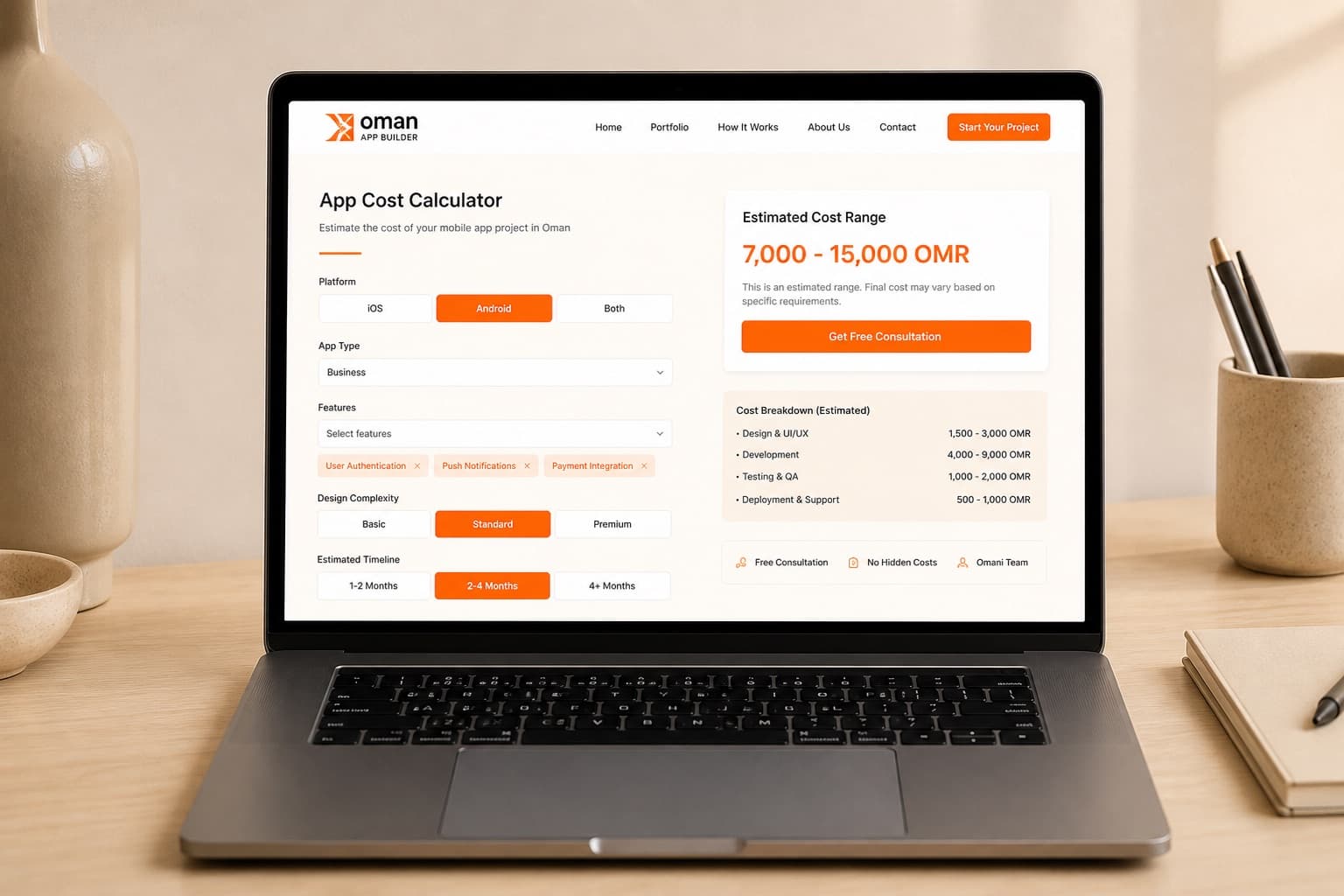
Business App Cost Calculator (Oman)
Select complexity, core focus, and platform to estimate a directional OMR range for planning conversations.
Directional estimate
OMR 3,315 – 5,738
Planning range only — not a fixed quote. Integrations, Arabic RTL, and content readiness can move the number. Request a scoped estimate.
How to Build a Business App in Oman: A Practical Guide for Business Owners
A business owner in Muscat once told me he’d spent four months and nearly 8,000 OMR on an app that nobody in his own team could explain how to update. That’s not a rare story. It’s the default outcome when a business jumps into app development without a plan.
Building a business app in Oman isn’t complicated in theory. Pick a platform, hire a developer, launch. But in practice, most businesses get stuck somewhere between “we need an app” and “we have something customers actually use.”
The mistakes are predictable. Businesses skip market research and copy a competitor’s feature list. They pick a developer based on price instead of process. They launch on both iOS and Android at once, before they’ve even validated the idea with real users.
This guide walks through the actual process — not the theory — of building a business app in Oman, from your first decision to the moment it’s live in the App Store and Google Play.
What You'll Learn
Quick Summary: By the end of this guide, you’ll know how to plan, budget, build, and launch a business app in Oman — including realistic costs in OMR, a step-by-step timeline, the tools worth paying for, and the mistakes that quietly waste the most money.
- A clear step-by-step process from idea to launch
- Realistic cost ranges for the Omani market
- A comparison of native, hybrid, and no-code approaches
- A checklist of common mistakes that derail app projects
- A real-world case study showing how a local business approached it
9 steps
Idea → launch process
3–5 mo
Typical MVP timeline
OMR 3k–30k+
Cost bands for most SMEs
Why This Matters
Oman’s digital economy is growing fast, and mobile is where most of that growth is happening. Customers in Muscat, Salalah, and Sohar increasingly expect to book, order, or pay through a mobile app — not a website, and definitely not a phone call.
For a business, that shift creates real opportunity. An app can reduce dependence on third-party platforms that take a cut of every transaction. It can build direct loyalty through push notifications and rewards. It can collect data that helps you make better decisions about inventory, staffing, and marketing.
But there are real challenges too. Apps require ongoing maintenance, not just a one-time build. They need a marketing plan to get downloads. And in a market like Oman, where device diversity and data quality vary, performance and simplicity matter more than flashy design.
Step-by-Step Guide
Follow these nine steps in order. Skipping validation or MVP scoping is how budgets quietly explode.
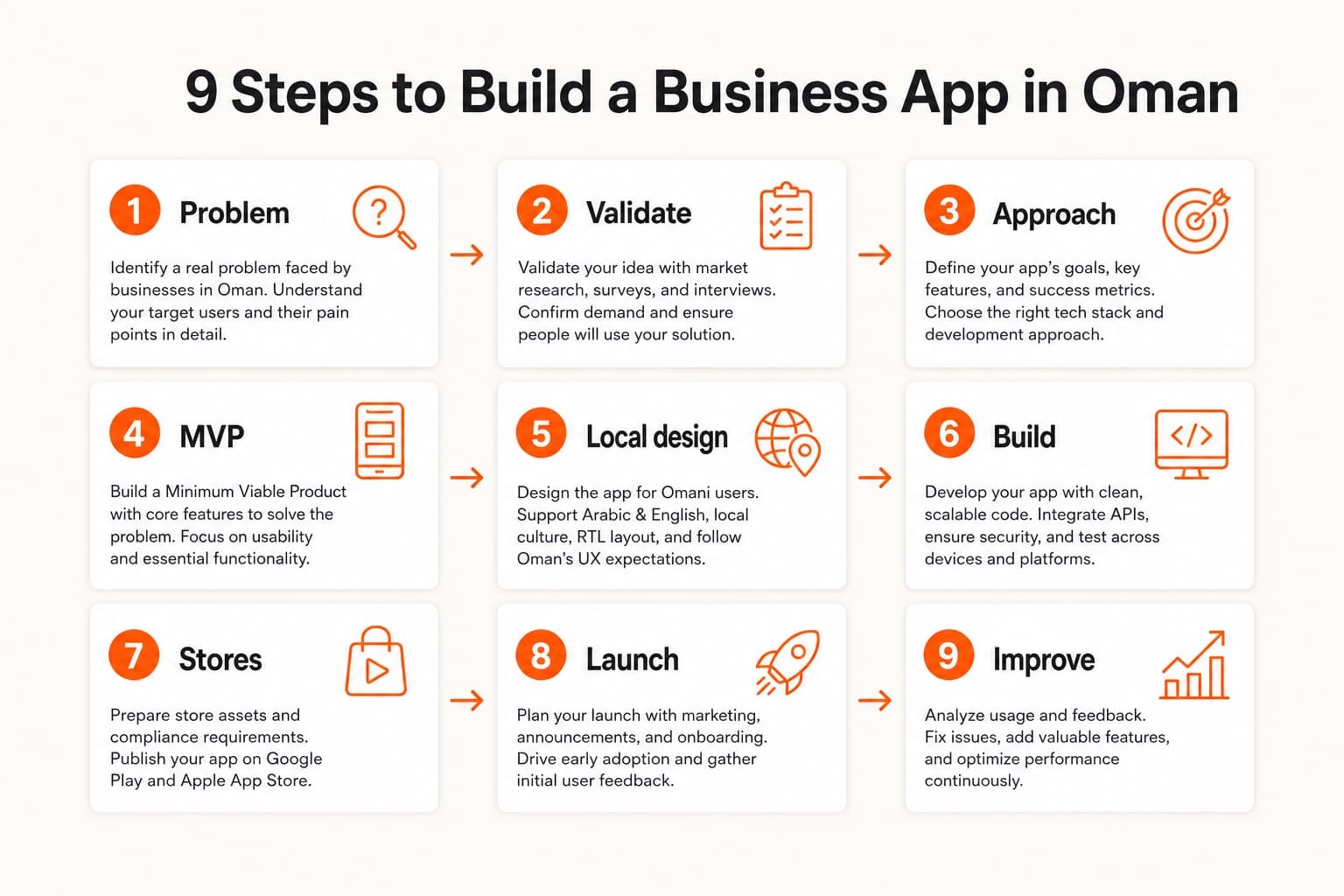
Step 1: Define the Problem Before the App
Start by writing down the exact problem your app solves — in one sentence, not a paragraph. “Customers can’t book appointments outside business hours” is a problem. “We need an app” is not.
Why it matters: every strong app starts from a clear problem, not a feature wishlist. Without this, you build features nobody asked for.
Practical tip: talk to 10 real customers before writing a single line of code. Ask what frustrates them about your current process.
Common mistake: assuming you already know what customers want because you talk to them daily. Owners often overestimate how well they understand friction points.
Real example: a Muscat salon chain assumed customers wanted loyalty points. Interviews showed the real pain was booking — seeing open slots without calling. The app pivoted to booking first, loyalty second.
Step 2: Validate Demand Before Building
Before committing budget, test whether people actually want this. A landing page with a “Join the waitlist” button and a small local ad budget is enough to start.
Why it matters: validation is far cheaper than building the wrong app. A landing page costs a few hundred OMR; a full app costs thousands.
Practical tip: aim for meaningful interest (often 100–200 sign-ups, adjusted for business size) before funding a full build.
Common mistake: skipping validation because “we already know our customers need this.” Confidence isn’t data.
Real example: a Sohar grocery idea tested demand with WhatsApp ordering first. Order volume confirmed demand and shaped delivery zones and payment methods.
Step 3: Choose Your Development Approach
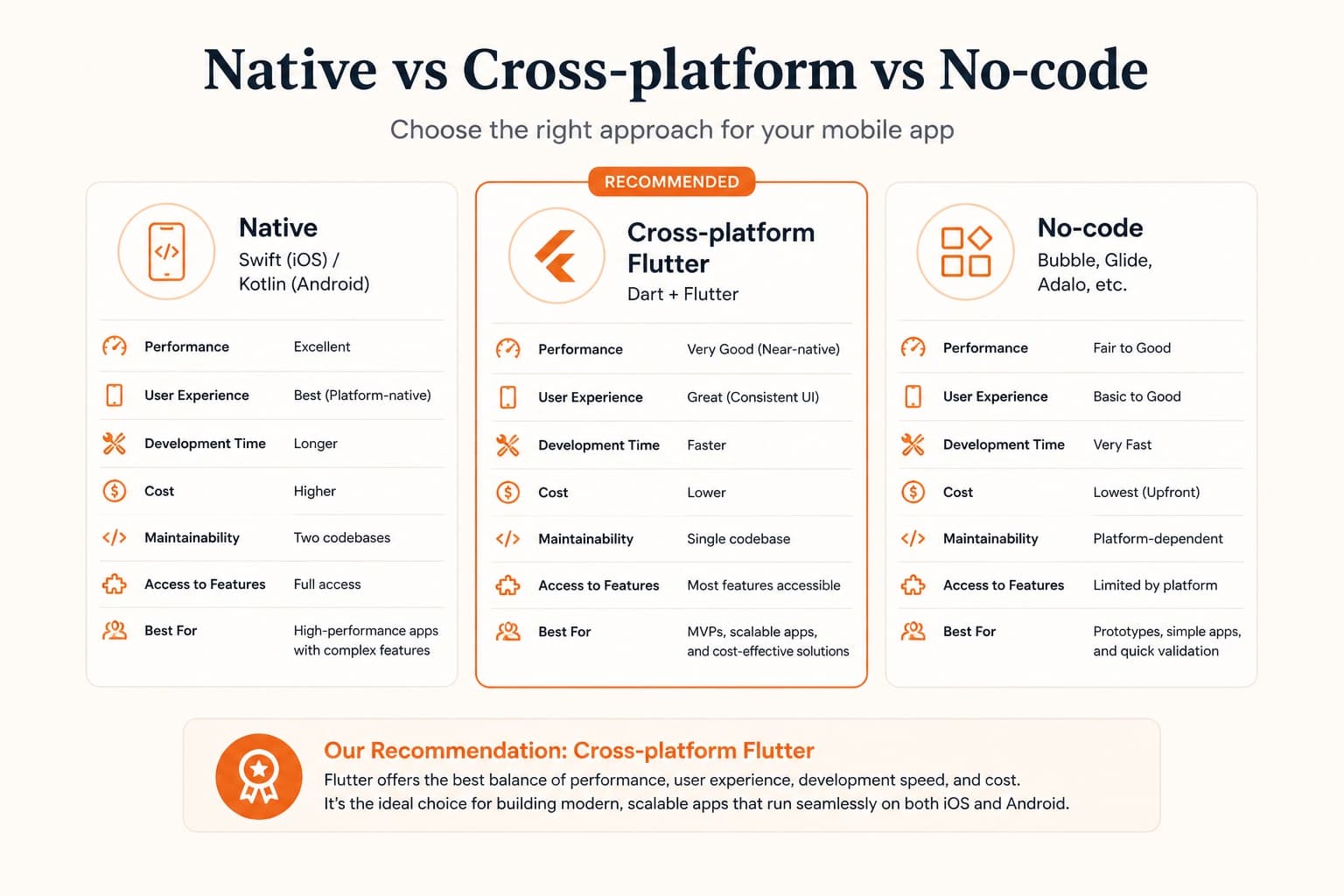
Decide between native development (separate iOS and Android codebases), cross-platform frameworks (Flutter or React Native), or no-code/low-code platforms.
Why it matters: this decision affects cost, timeline, performance, and how easily you update later. Reversing mid-project is expensive.
Practical tip: for most small-to-mid Omani businesses, Flutter offers the best balance of cost, speed, and quality for a first version.
Common mistake: choosing native for both platforms too early, doubling cost before the model is proven.
Real example: a Muscat restaurant group switched from dual native plans to one Flutter codebase and cut development time by roughly 40% with no meaningful drop in customer experience.
Step 4: Plan Core Features for Version One
List every feature you want, then ruthlessly cut to what’s needed for a working first version — your MVP.
Why it matters: a smaller, well-built app beats a bloated, buggy one. Extra features mean extra cost and bugs.
Practical tip: group features into must-have, nice-to-have, and future. Only build must-haves for launch.
Common mistake: trying to match Talabat or Careem feature-for-feature in version one.
Real example: an Omani logistics startup cut live GPS chat and loyalty from launch and shipped booking plus status updates — the trust features users needed first.
Step 5: Design for Local Users First
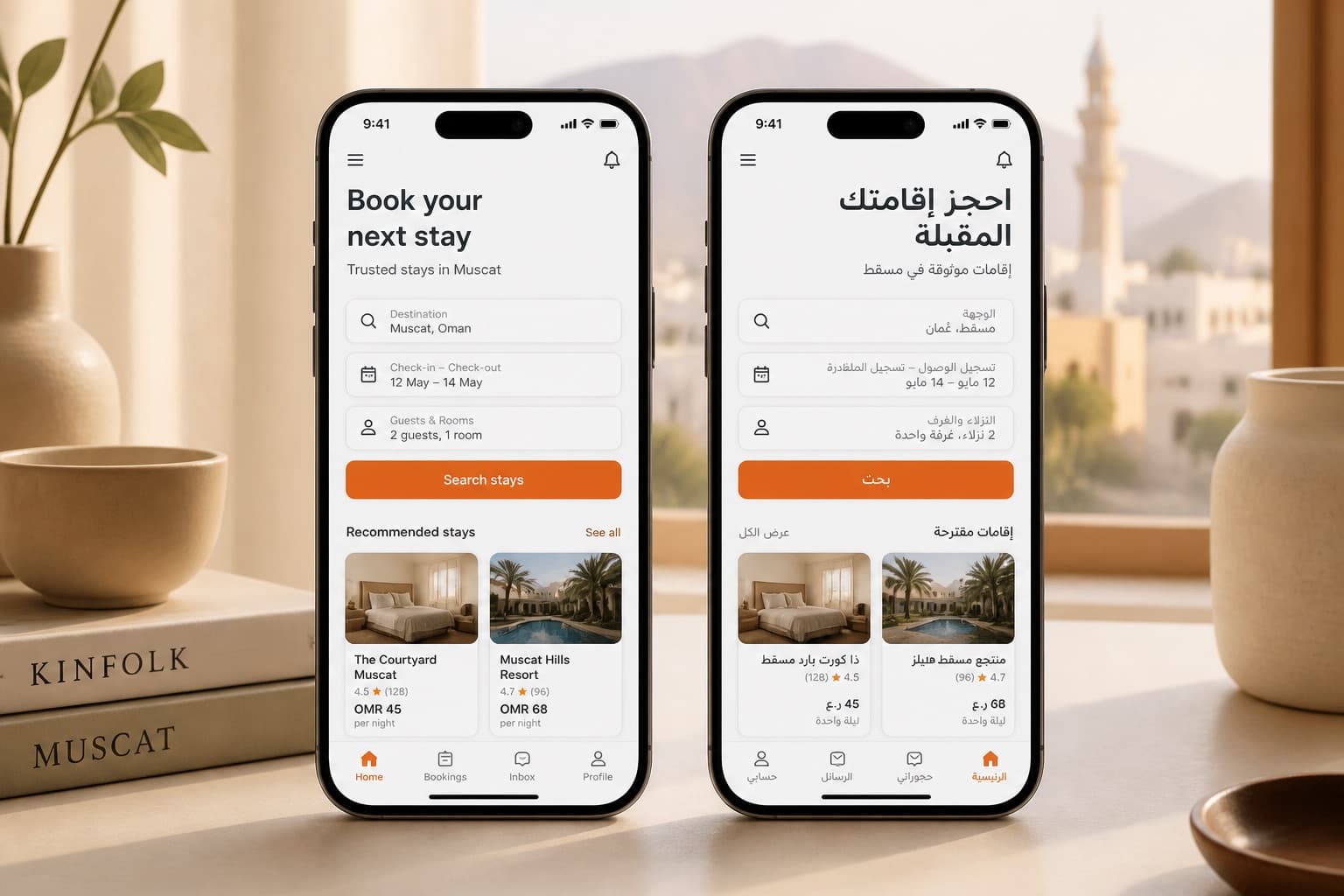
Design around how Omani users behave — bilingual Arabic/English, RTL layout considerations, local payment methods, and strong performance on mid-range devices.
Why it matters: a polished app that ignores local context loses to a simpler, locally tuned one.
Practical tip: build Arabic support into the architecture from day one, even if you launch English-first. Retrofitting RTL later is expensive.
Common mistake: copying Western UX and assuming everyone uses cards — many users still prefer COD or local wallets.
Real example: an e-commerce app added Arabic plus COD and saw noticeably better completion outside Muscat’s densest areas.
Step 6: Build and Test in Phases
Break development into short phases (often ~2-week sprints) with working, testable builds at the end of each — not one long build and a single big reveal.
Why it matters: phased work catches problems early, when fixes are cheap.
Practical tip: insist on a working build every two weeks. If a team can’t show progress that often, treat it as a warning sign.
Common mistake: waiting for the “final” build before testing with real users.
Real example: weekly tests with five users caught a confusing checkout flow three weeks before launch — cheap then, expensive after release.
Step 7: Prepare for App Store & Google Play Submission
Set up developer accounts, store listings (screenshots, descriptions, privacy policy), and review requirements before you’re ready to submit.
Why it matters: store review can take days and reject apps for non-code issues like privacy gaps or misleading screenshots.
Practical tip: start Apple Developer and Google Play Console setup in parallel with development.
Common mistake: a generic privacy policy that under-discloses data collection — a frequent rejection cause.
Real example: a retail app was rejected twice over loyalty-program data language; clarifying the policy cost two extra weeks.
Step 8: Launch and Market Simultaneously
Treat launch day as a marketing event, not only a technical release. Coordinate social channels, existing customers, and any waitlist from validation.
Why it matters: apps aren’t discovered by accident. A good app with zero awareness still fails.
Practical tip: use your validation list as the first wave of downloads and reviews — early reviews help store ranking.
Common mistake: launching quietly and hoping for organic growth with no incentive.
Real example: a Muscat retail brand ran a launch-week discount exclusive to the app and got usage data within the first 10 days.
Step 9: Monitor, Support, and Improve After Launch
Set up analytics, crash reporting, and a support channel from day one. Review usage weekly for the first two months.
Why it matters: version one is a starting point. Real behavior tells you what to fix next.
Practical tip: track which features are actually used with Firebase Analytics or Mixpanel — not which ones you assumed would win.
Common mistake: treating post-launch as “done” and moving all developer time elsewhere.
Real example: analytics showed 60% drop-off at payment; a simpler checkout a month later recovered a large share of lost conversions.
Tools You'll Need
Flutter is a strong default for one codebase on iOS and Android. Firebase helps with auth, notifications, analytics, and a fast backend start. Figma covers design before code. App Store Connect and Google Play Console handle publishing. Mixpanel or Firebase Analytics show real usage. Postman helps developers test APIs. Trello or Notion keep sprints visible.
Pick tools your team will actually operate after launch — fancy stacks that only the agency understands become expensive quickly.
Timeline
Quick Summary: most well-run MVP projects in Oman take between three and five months from initial idea to public launch. Rushed timelines under two months usually mean cut corners in testing or design.
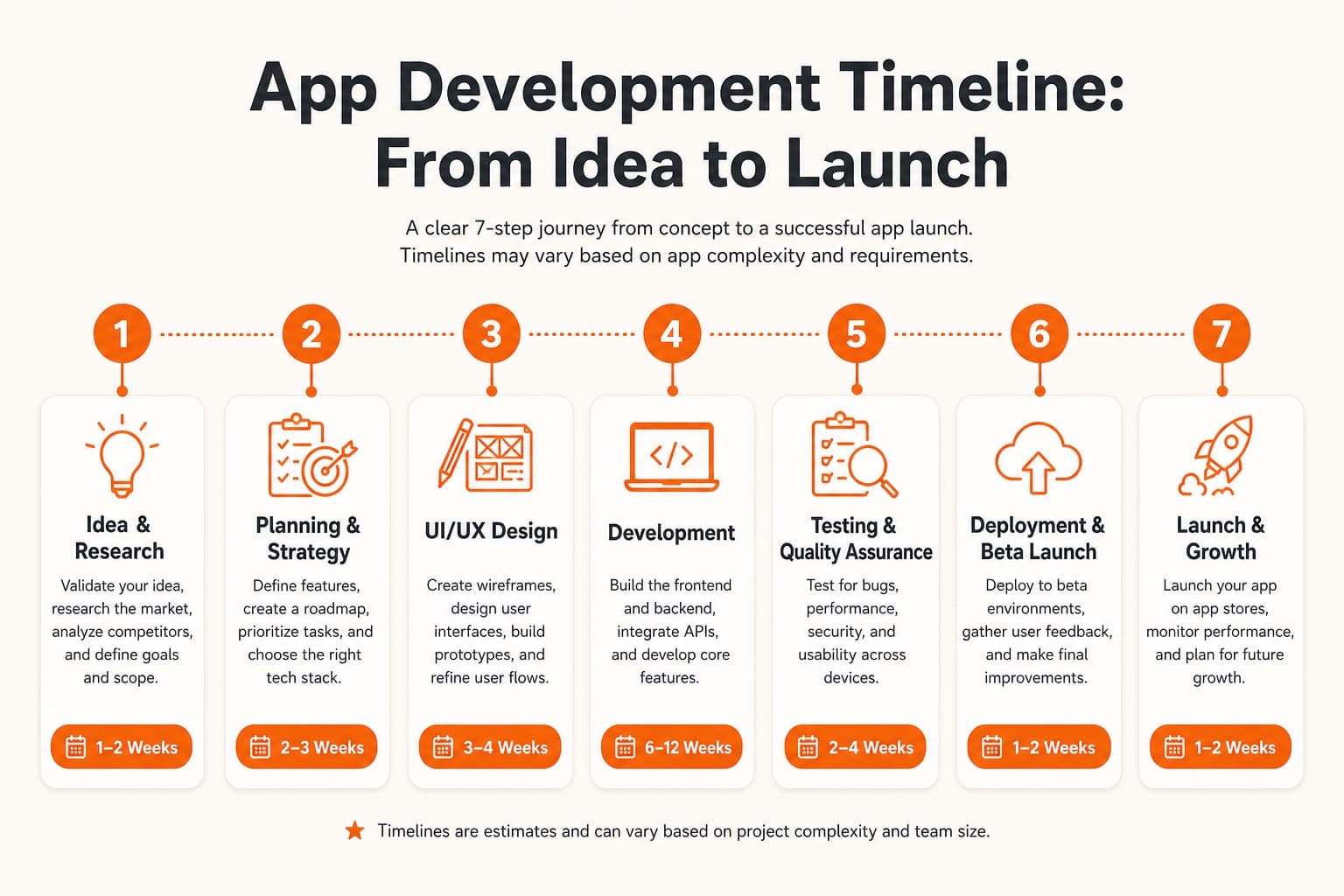
Phase durations
Typical ranges for a focused Oman MVP
Swipe sideways to see all columns →
| Phase | Typical duration | Notes |
|---|---|---|
| Problem definition & validation | 2–4 weeks | Landing page / waitlist tests |
| Planning & feature scoping | 1–2 weeks | MVP freeze |
| UI/UX design | 2–4 weeks | Flows + prototypes |
| Development (MVP) | 6–12 weeks | Phased builds |
| Testing & QA | 2–3 weeks | Real devices |
| Store submission | 1–2 weeks | Review buffer |
| Total idea → launch | Roughly 3–5 months | Well-run projects |
Estimated Cost
Costs vary by complexity. Directional Oman ranges: Simple MVP often ~750–3,000 OMR; mid-complexity apps ~3,000–9,500 OMR; complex real-time/multi-role apps often 9,500–20,000+ OMR.
Use the calculator and bars on this page for planning conversations — not as a fixed invoice. What’s included (QA, store submission, post-launch support, bilingual QA) matters as much as the headline number.
Planning bands (OMR)
Realistic Oman market ranges for professional builds
Simple MVP
Often 8–12 weeks
OMR 3,000 – 7,000
Mid-complexity
Often 10–16 weeks
OMR 7,000 – 15,000
Complex / real-time
4–7+ months
OMR 15,000 – 30,000
Best Practices
If budget is tight, start on one platform based on where customers actually are. Build bilingual architecture early. Keep version one small and functional. Set up analytics before launch. Budget 15–20% of build cost for early post-launch fixes. Choose a developer who explains trade-offs clearly. Test on mid-range Android devices, not only the newest iPhone.
Before you build checklist
Validation, budget, and developer questions
- One-sentence problem statement written down
- At least light validation (waitlist, WhatsApp flow, or landing page)
- Must-have / nice-to-have / future feature lists
- Platform decision explained in plain language
- Arabic/English & RTL considered in architecture
- Local payments / COD preferences listed
- Post-launch budget reserved (about 15–20% of build)
- Source-code ownership confirmed in the contract
- Staging environment and analytics planned
- Store accounts started in parallel with development
Common Mistakes to Avoid
Skip these if you want fewer surprises.
- Skipping market validation and building on assumptions
- Choosing native for both platforms too early
- Overloading version one with features
- Ignoring Arabic/RTL until later
- Picking a developer on price alone
- No post-launch budget
- Weak or generic privacy policy causing rejections
- No analytics at launch
- Launching without a marketing plan
- Not testing on varied real devices
- Underestimating store review time
- Ignoring local payment preferences
Expert Tips
Negotiate ownership of source code and design files upfront — some contracts leave rights with the agency unless stated otherwise.
Ask for a staging environment so updates can be tested without touching live users.
Plan data structure for growth; restructuring databases after launch is expensive.
Consider a soft launch in Muscat before a nationwide push.
Build a lightweight admin panel from day one — manually editing databases doesn’t scale.
Case Study
The problem: a mid-sized Muscat home-services business (cleaning, maintenance, minor repairs) relied on phone bookings and WhatsApp. Growth created missed appointments and messy payments.
The solution: they validated with a simple booking form promoted via Instagram and WhatsApp. Over 150 sign-ups in three weeks confirmed demand. Then they built a Flutter + Firebase MVP with three features only — service booking, staff assignment visibility, and payment confirmation.
The outcome: launch within about four months near the lower mid-complexity cost band. Missed appointments dropped in the first two months, and the owner finally had data on which services sold most.
Lessons learned: starting small was the reason the project hit time and budget. Features like chat and loyalty still weren’t requested months later.
Comparison Table: Development Approaches
Use the table above to compare native, cross-platform, and no-code. For most Oman SME first products, cross-platform (especially Flutter) is the practical default; native is for specialized needs; no-code is best for validation and very simple apps.
Native vs cross-platform vs no-code
Pick based on budget, speed, and long-term needs
Swipe sideways to see all columns →
| Approach | Cost & speed | Best for / limitations |
|---|---|---|
| Native (iOS + Android separately) | Highest cost · Slowest launch | Best for deep platform needs · Double codebase & maintenance |
| Cross-platform (Flutter / React Native) | Moderate cost · Moderate–fast | Best for most SME first apps · Minor trade-offs for heavy graphics |
| No-code / low-code | Lowest cost · Fastest | Best for validation / simple apps · Limited customization at scale |
Key Statistics
Illustrative context — verify with current TRA Oman / GCC research before quoting externally: smartphone readiness in Oman is high; mobile commerce continues to grow across the GCC; a meaningful share of downloads still comes from referrals and social, not store search alone — which is why launch marketing matters.
Frequently Asked Questions
How much does it cost to build a business app in Oman? Typically about 750 OMR for a simple MVP up to 20,000+ OMR for complex real-time products, depending on scope and platforms.
How long does it take? Most well-planned MVPs take three to five months idea-to-launch including validation, design, build, and store review.
iOS, Android, or both? Start where your customers are. Expand after the core journey works.
Is Flutter a good choice in Oman? Yes for most SME first apps — one codebase for iOS and Android with a strong cost/speed balance.
Do I need Arabic? Usually yes. Building bilingual support early is cheaper than adding it later.
Biggest mistake? Skipping validation and building on assumptions.
Do I need Apple and Google developer accounts? Yes if launching on both platforms.
What belongs in version one? Only features required to solve the core problem.
How do I market after launch? Use existing channels, launch incentives, and ask early users for reviews.
Ongoing costs? Plan ~15–20% of build cost for early fixes, hosting/backend, and small updates.
Can I build without coding? No-code works for simple cases, with limited scale/customization.
How do I choose a developer? Clear trade-offs, similar portfolio, transparent inclusions/exclusions, and post-launch support.
What if Apple rejects the app? Fix the stated issue and resubmit — privacy and clarity issues are common and usually fixable.
Nationwide or one city? Soft-launching in Muscat first is often smarter.
Who owns the source code? Put full ownership in the contract before you sign.
Conclusion
Building a business app in Oman isn’t about the flashiest features or the fastest quote — it’s about solving one real problem well, testing it with real customers, and growing from there.
The businesses that succeed treat version one as a starting point. They validate before they build, keep v1 focused, and budget for what comes after launch.
If you’re at the beginning, start smaller than you think you need to. A focused, well-tested app that solves one problem will outperform a feature-packed app that does nothing well.
Get Professional Help
If you’re planning a business app in Oman and want to avoid the costly mistakes in this guide, I can help you plan it properly — from validating the idea to choosing the right development approach for your budget and timeline.
Book a free consultation or request a quote to discuss your project, or browse the portfolio of apps and platforms built for regional businesses.
Portfolio case study
Want the full engineering write-up?
Continue to the complete portfolio case study for architecture, features, challenges, results, and next-step CTAs.
Delyt Flutter delivery case study