Mobile App Development
How to Build a Restaurant App in Qatar (2026 Guide)
A practical, step-by-step guide to building a restaurant app in Qatar — costs, timelines, tools, and mistakes to avoid, from someone who's built these apps.
2026-08-07 · 26 min read
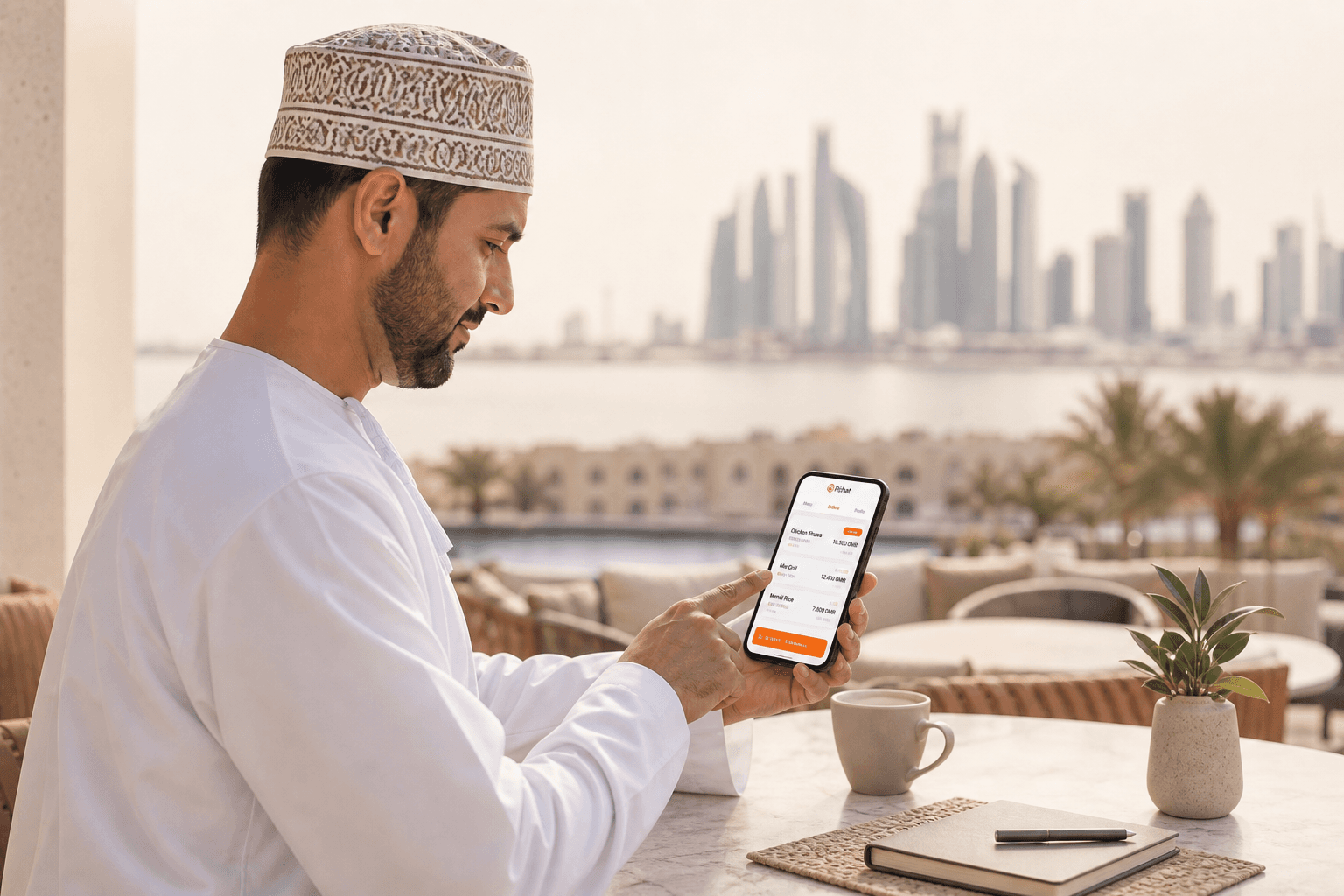
Restaurant App Cost Calculator (Qatar)
Pick app scope, platform approach, and complexity for a directional QAR range — then validate with a real brief.
Directional estimate
QAR 36,465 – 63,113
Planning range only — not a fixed quote. Integrations, Arabic RTL, and content readiness can move the number. Request a scoped estimate.
How to Build a Restaurant App in Qatar: A Step-by-Step Guide
A restaurant owner in West Bay once told me he lost more customers to a slow phone call than to his competitor down the street. His kitchen was busy, the line stayed on hold, and the order went to someone else. That's the moment he decided to build an app — not because it was trendy, but because it was costing him money every single night.
That story isn't unusual in Qatar. The country has one of the highest smartphone penetration rates in the Gulf, and diners here expect to order, pay, and track their food without picking up a phone. If your restaurant doesn't offer that, a competitor a few streets away probably does.
But here's where most restaurant owners go wrong: they either overbuild (spending on features nobody uses) or underbuild (launching something so basic it can't compete with Talabat or Snoonu on user experience). Both mistakes are expensive, and both are avoidable if you know the steps in the right order.
This guide walks through exactly how to build a restaurant app in Qatar — from the first planning conversation to the day it goes live on the App Store and Google Play.
What You'll Learn
Quick Summary
- How to plan a restaurant app that fits your actual business, not a generic template
- The real cost ranges for building an app in Qatar in 2026
- A realistic timeline, step by step
- The tools and tech stack decisions that matter most
- Mistakes that quietly kill restaurant apps after launch
- A case study showing how this plays out in practice
10 steps
Plan → launch process
10–16 wk
Typical MVP timeline
QAR 60–150k
Full ordering + tracking
Why This Matters
An app isn't just a digital menu. Done right, it becomes your most profitable sales channel because you're not paying 20–30% commission to a third-party delivery platform on every order.
Restaurants that run their own ordering app alongside marketplace apps like Talabat typically see higher margins on app-direct orders, better customer data (who's ordering, how often, what they like), and more control over promotions and loyalty programs.
The benefits: lower commission costs compared to relying solely on delivery marketplaces; direct customer relationships — you own the data, not the platform; repeat business tools — push notifications, loyalty points, birthday offers; and brand control — your app looks like your restaurant, not a listing among fifty others.
The challenges: customer acquisition is harder without marketplace foot traffic; you're responsible for uptime, bugs, and updates; delivery logistics (your own riders vs. third-party) need a real plan; and ongoing costs don't stop at launch — maintenance is a real budget line.
None of these challenges are dealbreakers. They're just things that need a plan before you start building, not after.
Step-by-Step Guide
Follow these ten steps in order. Skipping MVP focus or admin tooling is how budgets quietly explode.
Step 1: Define Your Core Use Case
What to do: Decide, in one sentence, what the app is for. Dine-in ordering? Delivery? Both? Pre-ordering for pickup? This decision shapes every feature decision after it.
Why it matters: Restaurant owners often try to build "everything" in version one — dine-in QR ordering, delivery, loyalty, reservations, all at once. That's how a QAR 60,000 app becomes a QAR 150,000 app with a six-month delay.
Practical tips: write down your top 3 customer pain points before touching design; talk to your actual staff — they know where orders get lost or delayed; and look at your last 100 customer complaints for patterns.
Common mistake: Copying a competitor's feature list instead of solving your own restaurant's specific problem.
Real business example: A shawarma chain in Al Sadd wanted delivery, loyalty, and table booking all in v1. We convinced them to launch with delivery + simple loyalty only. It shipped in 10 weeks instead of 20, and they added table booking six months later once delivery was already generating revenue to justify it.
Step 2: Choose Your Development Approach
What to do: Decide between a custom-built app, a white-label/template solution, or a hybrid (template backend + custom frontend).
Why it matters: This single decision affects your cost, timeline, and how much control you'll have later. Custom apps cost more upfront but scale better. White-label apps launch faster but limit customization.
Practical tips: if you're a single restaurant testing the waters, white-label can be a smart first step; if you're a multi-branch chain, custom development pays off within 1–2 years; ask any vendor: "What happens if I want to add a feature you don't support?" Their answer tells you everything.
Common mistake: Choosing the cheapest option without checking what happens after year one — some white-label platforms lock you into ongoing fees that add up to more than custom development would have cost.
Real business example: A café chain with 4 branches in Doha started with a white-label app to test demand. Within a year, order volume justified switching to a custom build — but they had to rebuild their customer database from scratch because the white-label platform didn't allow data export.
Step 3: Plan the Core Features
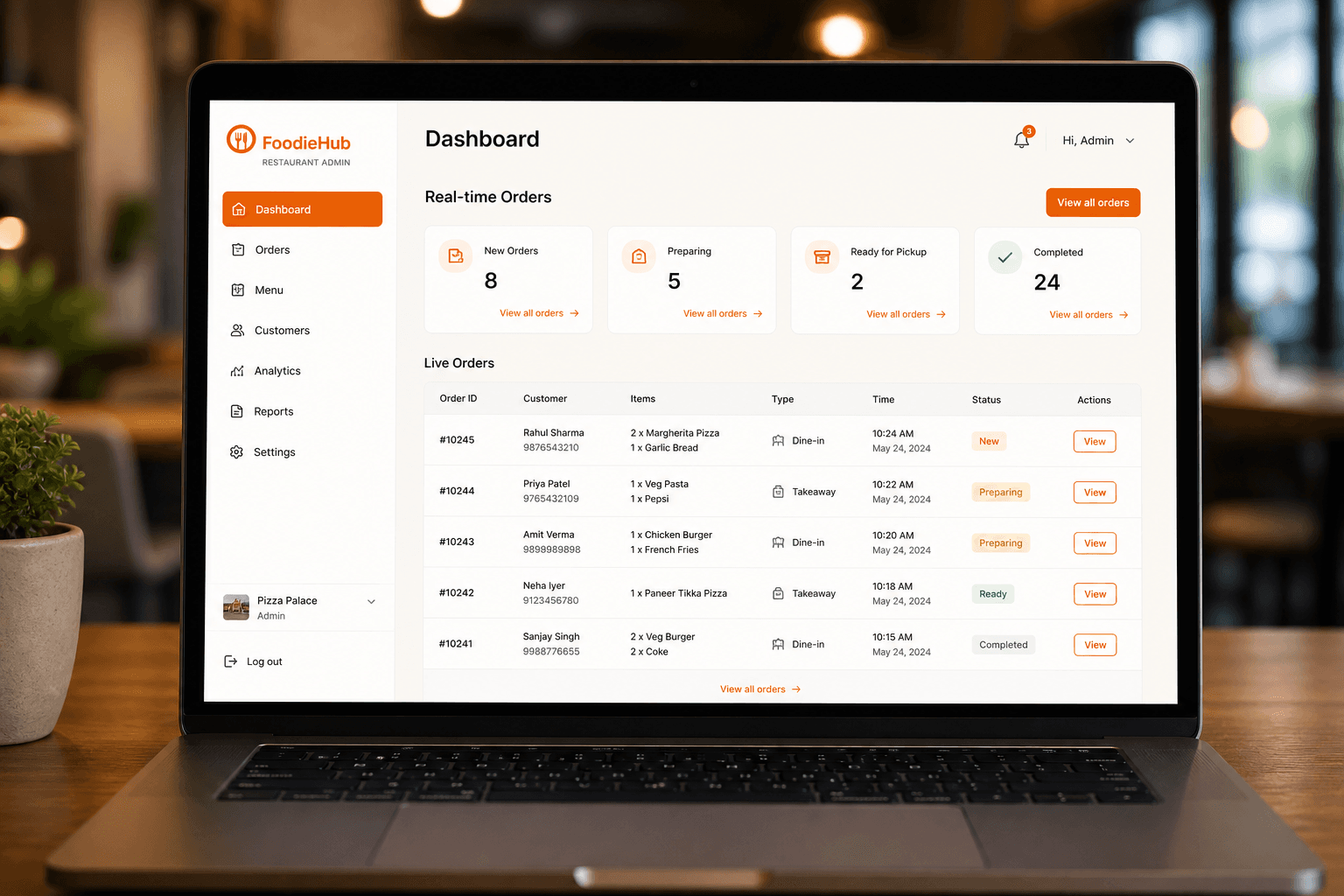
What to do: Build your feature list around three groups: customer-facing app, restaurant/admin dashboard, and (if applicable) a driver app for delivery.
Why it matters: Restaurant apps aren't one app — they're usually a small ecosystem. Skipping the admin dashboard is one of the most common early mistakes, because restaurant staff end up managing orders manually anyway.
Practical tips — customer app: menu browsing, cart, order tracking, payments, order history. Admin dashboard: order management, menu editing, sales reports, push notification tools. Driver app (if self-delivery): route assignment, live location sharing, order status updates.
Common mistake: Building a beautiful customer app with no proper admin panel, forcing staff to manage orders through WhatsApp or phone calls anyway.
Real business example: A Doha-based Pakistani restaurant launched a customer app but had no admin dashboard — staff had to check a shared tablet constantly, and orders were missed during rush hours. Adding a proper dashboard later cost more than building it right the first time would have.
Step 4: Choose the Right Tech Stack
What to do: Decide between native development (Swift for iOS, Kotlin for Android) or cross-platform frameworks (Flutter, React Native).
Why it matters: For most restaurant apps, cross-platform development (especially Flutter) is the practical choice — one codebase, two platforms, faster launch, lower cost.
Practical tips: Flutter is a strong default for restaurant apps unless you need very specific native performance (rare for this use case); confirm your backend can handle real-time order status updates and live delivery tracking; ask your developer directly which state management and backend approach they'll use, and why.
Common mistake: Choosing native development for both platforms when the app doesn't need platform-specific performance — this roughly doubles cost and timeline for no real benefit.
Real business example: Similar to how we approached the Delyt restaurant app case study on this site — a single Flutter codebase covered both iOS and Android, cutting development time significantly compared to building two native apps separately.
Step 5: Design for How Qatar Diners Actually Order
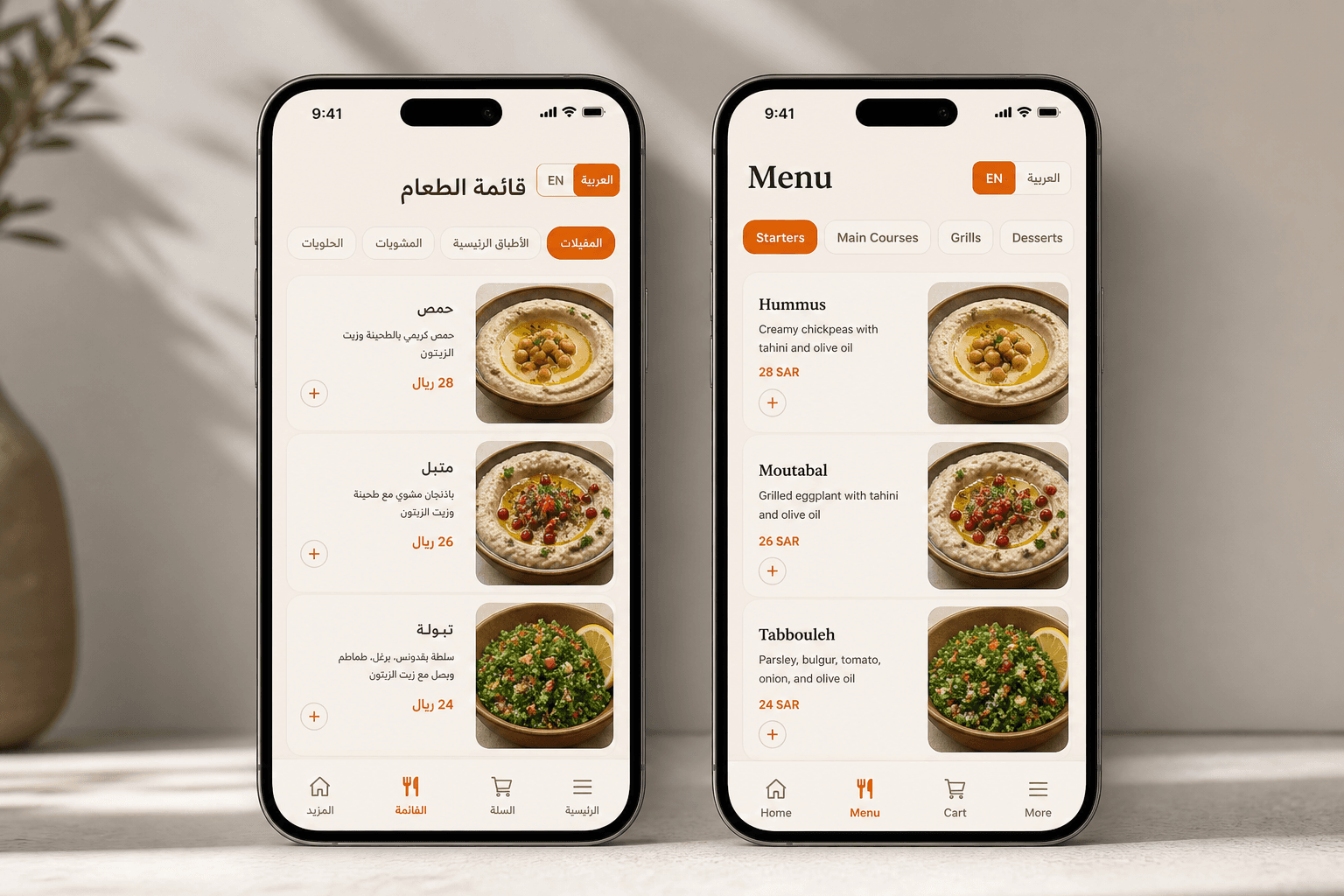
What to do: Design the ordering flow around local behavior — bilingual support (Arabic/English), local payment methods, and delivery zones that make sense for Doha and surrounding areas.
Why it matters: An app built without Arabic language support, or without local payment gateway integration, will underperform no matter how good the UI looks.
Practical tips: support both Arabic and English from day one, not as a "phase two" feature; integrate local payment options alongside international ones; map realistic delivery zones — don't promise coverage you can't fulfill.
Common mistake: Treating Arabic language support as an afterthought, which alienates a large share of the local customer base.
Real business example: An app that launched English-only initially saw a noticeable jump in orders after adding full Arabic support three months later — largely from customers who had downloaded the app but never completed an order.
Step 6: Build Real-Time Order & Delivery Tracking
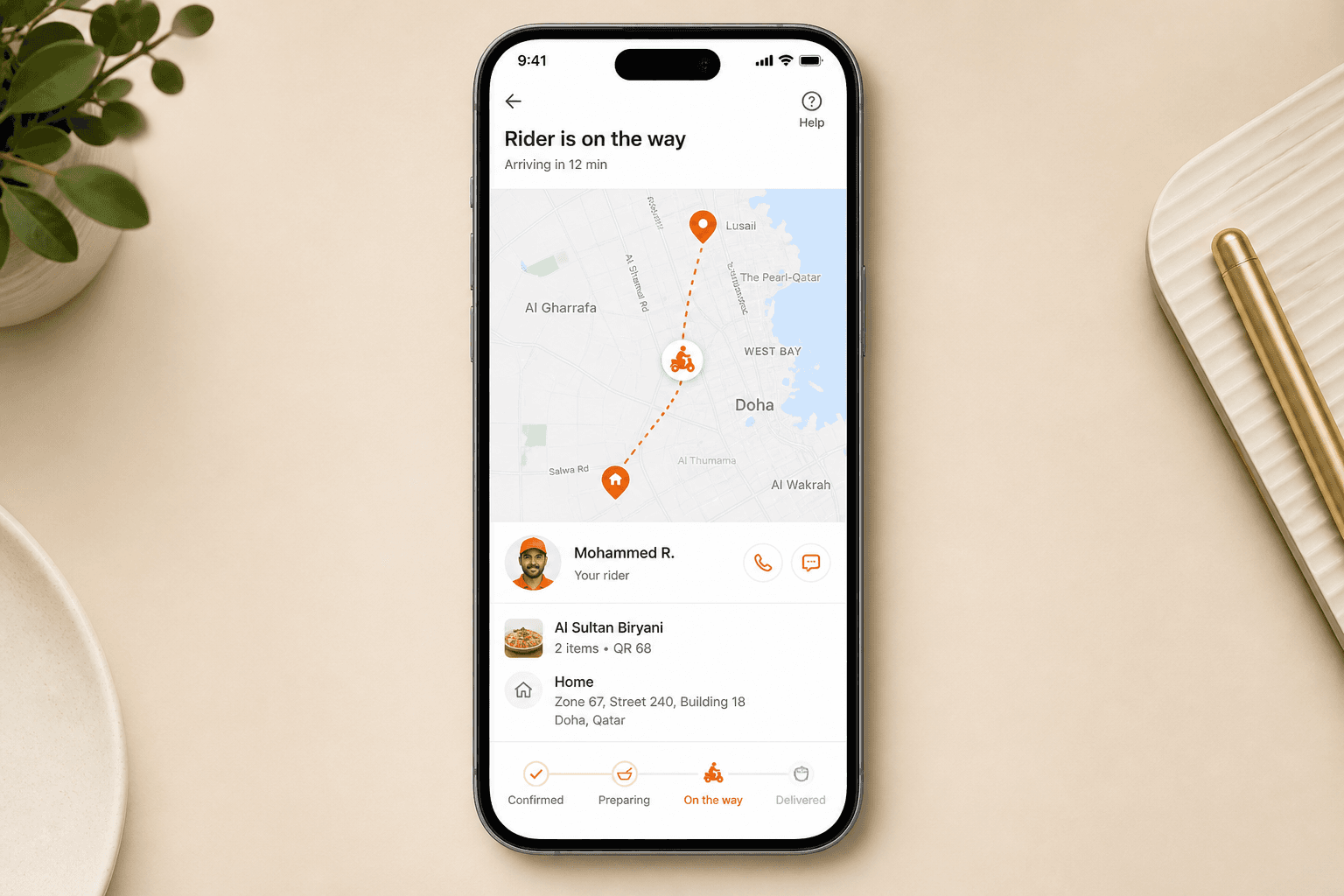
What to do: Implement live order status updates and, if you offer delivery, real-time rider tracking on a map.
Why it matters: Customers in Qatar are used to Talabat-level tracking. An app that just says "Order Placed" with no further updates feels broken by comparison, even if the food arrives on time.
Practical tips: use a real-time database (Firebase Realtime Database or Firestore are common, cost-effective choices); throttle location updates (every few seconds, not continuous streaming) to control both battery drain and backend costs; show estimated arrival time, not just a status label.
Common mistake: Building order tracking that only updates on app refresh instead of pushing live updates automatically.
Real business example: This mirrors the approach used in the Poole ride-booking case study on this site — Firebase-powered live tracking with throttled updates kept the experience smooth without excessive backend costs.
Step 7: Set Up Payments and Compliance
What to do: Integrate secure payment gateways that work well in Qatar, and make sure your app complies with local data protection expectations.
Why it matters: Payment failures are one of the top reasons customers abandon an order mid-checkout. A smooth, trusted payment flow directly affects revenue.
Practical tips: offer both card payment and cash-on-delivery where relevant; test the full payment flow on real devices, not just a sandbox environment; store customer data securely and be transparent about how it's used.
Common mistake: Skipping cash-on-delivery entirely because it's "old-fashioned" — many customers in Qatar still prefer it, especially for first-time orders with a new restaurant app.
Step 8: Test With Real Staff and Real Customers
What to do: Run a soft launch with a small group of loyal customers and your actual restaurant staff before a full public launch.
Why it matters: Bugs that never show up in a developer's testing environment show up immediately during a real dinner rush.
Practical tips: soft-launch for 1–2 weeks with a limited customer group; have staff use the admin dashboard during actual service hours; collect feedback actively — don't wait for app store reviews to tell you what's broken.
Common mistake: Launching publicly on day one without any real-world testing, then discovering critical issues during your busiest hours.
Step 9: Launch and Market the App
What to do: Coordinate your App Store/Google Play launch with in-restaurant promotion — table cards, staff mentions, social media, and a launch-week incentive.
Why it matters: Even a great app gets zero downloads if nobody knows it exists. Your existing customers are your first and easiest install base.
Practical tips: put a QR code on every table and receipt; offer a first-order discount exclusive to the app; ask staff to mention the app at checkout for two weeks straight.
Common mistake: Treating launch as a one-time announcement instead of a sustained 4–6 week push.
Step 10: Maintain, Update, and Improve
What to do: Budget for ongoing maintenance, bug fixes, and feature updates after launch — this isn't optional.
Why it matters: Apps that go untouched for months start breaking quietly as operating systems update. An app that worked perfectly at launch can stop working within a year without maintenance.
Practical tips: budget roughly 15–20% of your initial development cost per year for maintenance; review analytics monthly — where are customers dropping off?; ship small updates regularly rather than one big overhaul once a year.
Common mistake: Treating launch as the finish line instead of the starting point.
Tools You'll Need
You don't need every shiny tool on the market. You need a stack that covers design, a cross-platform app, realtime updates, maps, payments, analytics, store publishing, API testing, and basic project tracking.
Flutter + Firebase is a strong default for most Qatar restaurant MVPs. Pair that with Figma for design, a local payment gateway, Google Maps for delivery UX, and Analytics to see where orders stall.
Core Tools for a Qatar Restaurant App
A practical stack for Flutter-based ordering apps with live tracking and payments.
Swipe sideways to see all columns →
| Tool | Purpose | Best for |
|---|---|---|
| Flutter | Cross-platform app framework (free) | Single iOS + Android codebase |
| Firebase | Realtime DB, auth, notifications (freemium) | Live order and delivery tracking |
| Figma | UI/UX design and prototyping (freemium) | Designing before development |
| Google Maps SDK | Maps and location (paid, usage-based) | Tracking and address selection |
| Local payment gateway | Payment processing (transaction fees) | Secure in-app checkout |
| Firebase Analytics | User behavior tracking (free) | Finding drop-off points |
| App Store / Play Console | Publishing (paid fees) | iOS and Android release |
| Postman | API testing (free) | Backend integration checks |
| Trello / Notion | Project management (freemium) | Tracking build progress |
Timeline
A focused MVP typically takes roughly 10–16 weeks from planning to public launch.
Timelines stretch significantly if you're adding advanced features like multi-branch management, loyalty programs, or table reservations in version one.
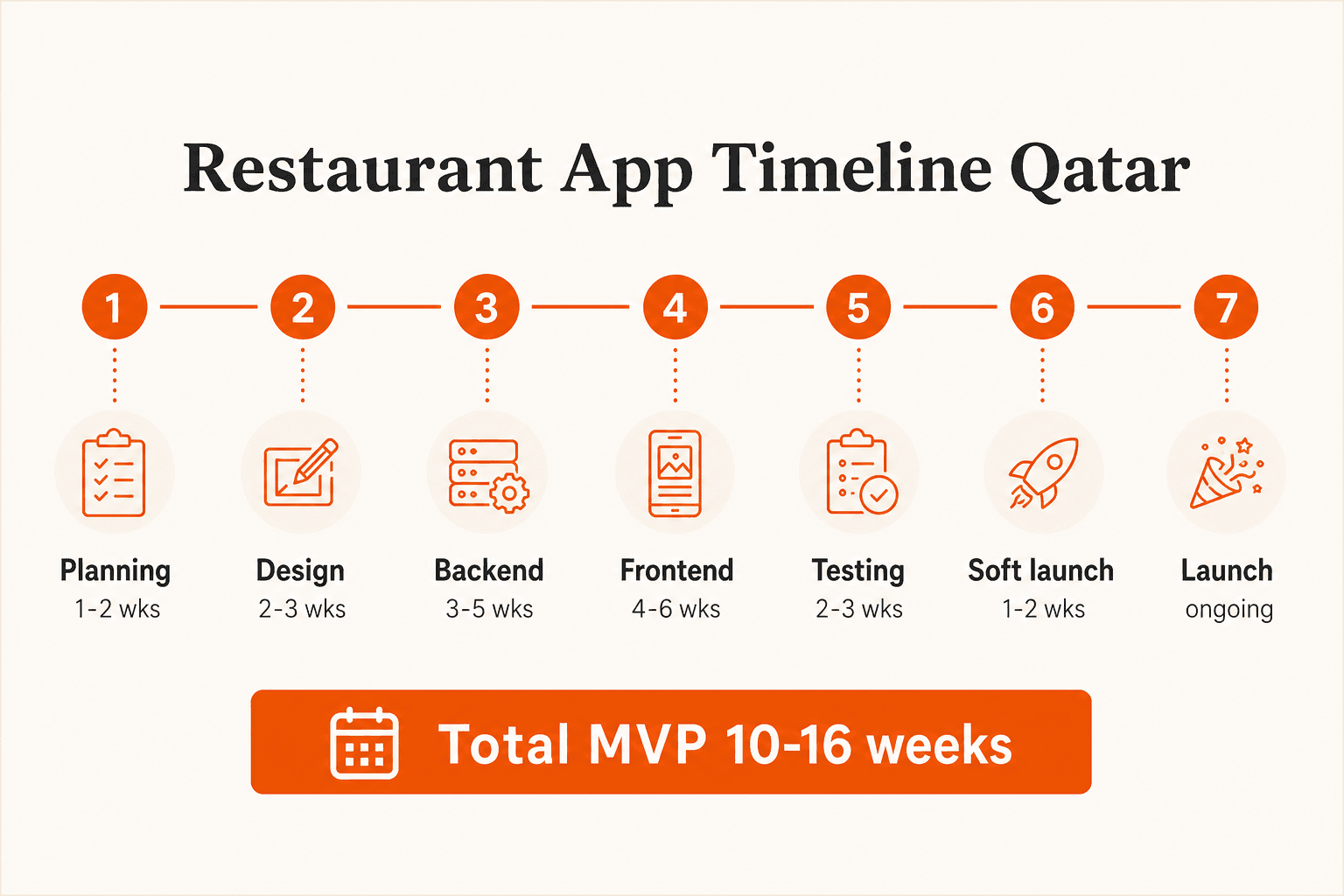
Restaurant App Timeline (MVP)
Indicative ranges for Qatar builds with ordering, payments, and tracking.
Swipe sideways to see all columns →
| Phase | Typical duration | Notes |
|---|---|---|
| Planning & feature scoping | 1–2 weeks | One-sentence use case first |
| UI/UX design | 2–3 weeks | Include Arabic/RTL early |
| Backend development | 3–5 weeks | Orders, menus, realtime |
| Frontend (app) development | 4–6 weeks | Flutter iOS + Android |
| Testing & bug fixing | 2–3 weeks | Real devices, real payments |
| Soft launch | 1–2 weeks | Staff + loyal customers |
| Public launch & marketing | Ongoing | 4–6 week push minimum |
| Total (MVP) | 10–16 weeks | Stretches with multi-branch extras |
Estimated Cost
Based on current Qatar market rates, here's a realistic range for a restaurant app with ordering, tracking, and payments:
Basic ordering app (menu + cart, no delivery tracking): QAR 40,000 – 70,000. Full restaurant app (ordering + real-time delivery tracking + payments): QAR 60,000 – 150,000. Multi-module app (customer + admin + driver apps): QAR 90,000 – 180,000+. Annual maintenance: 15–20% of initial development cost.
These ranges reflect typical Qatar market pricing as of 2026 and will vary based on your chosen developer, feature complexity, and whether you go custom or white-label.
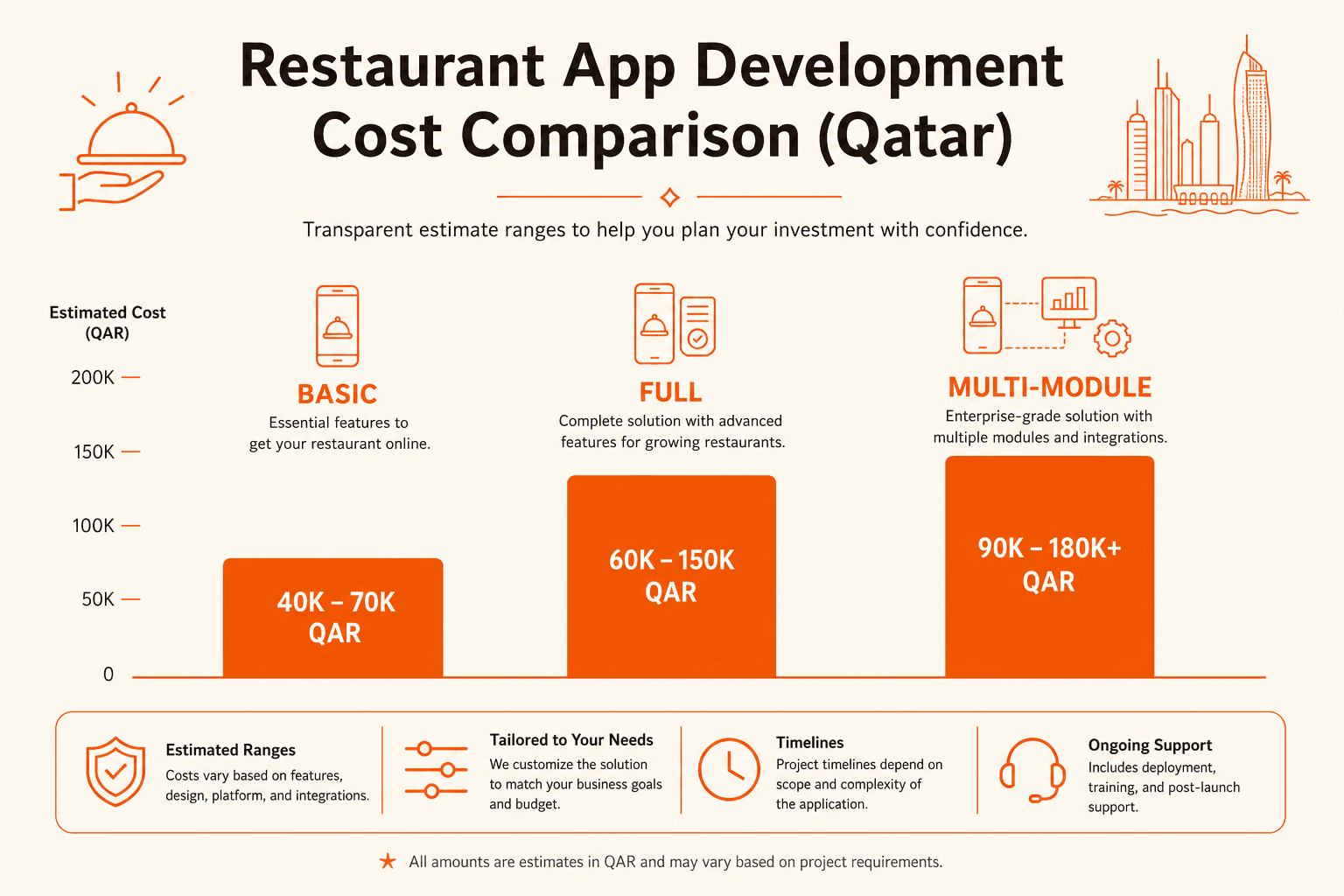
Restaurant App Cost Bands (Qatar, 2026)
Planning ranges in QAR — not fixed quotes.
Basic ordering
Faster MVP
QAR 40,000 – 70,000
Full + tracking
10–16 weeks
QAR 60,000 – 150,000
Multi-module
Longer build
QAR 90,000 – 180,000
Best Practices
Use these as non-negotiables for a Qatar restaurant MVP:
- Start with a focused MVP, not every feature you can imagine
- Design the admin dashboard with the same care as the customer app
- Support Arabic and English from day one
- Test payments and tracking on real devices in real conditions
- Budget for maintenance before you launch, not after something breaks
- Use your restaurant itself as your primary marketing channel
- Keep a direct line to your developer for the first 3 months post-launch
Pre-Launch Checklist
Use this before App Store and Google Play submission.
- One-sentence core use case documented
- Admin dashboard built and staff-tested during service hours
- Arabic and English flows verified by native speakers
- Card payments and cash-on-delivery both tested on real devices
- Realtime order updates verified (not refresh-only)
- Delivery zones mapped to what you can actually fulfill
- Soft launch completed with loyal customers + staff
- Table cards / QR codes and launch-week offer ready
- Maintenance budget reserved (15–20% of build / year)
- Data ownership and export rights confirmed in writing
Common Mistakes to Avoid
These are the patterns that quietly waste the most money:
- Trying to build everything in version one — leads to blown budgets and delayed launches
- Skipping the admin dashboard — forces staff back to manual order management
- Ignoring Arabic language support — alienates a large share of local customers
- Choosing the cheapest developer without checking past work — quality gaps show up after launch, not before
- No cash-on-delivery option — many Qatar customers still prefer it, especially for first orders
- Weak or missing order tracking — customers compare your app to Talabat/Snoonu whether you like it or not
- No soft launch or real-world testing — bugs surface during your busiest hours instead of during testing
- Underestimating delivery zone logistics — promising coverage you can't reliably fulfill
- No post-launch maintenance budget — apps quietly break as OS versions update
- Treating launch as the finish line — marketing and iteration matter more than the launch day itself
- Not owning your customer data — some white-label platforms don't allow data export if you switch later
- Overcomplicating the checkout flow — every extra step reduces completed orders
Expert Tips
These are the details I push clients on before contracts get signed:
- Negotiate a fixed price for a clearly defined MVP scope, and treat anything beyond that as a separate phase — this keeps costs predictable
- Ask to see the actual codebase quality, not just the finished app, if you're paying for custom development — a working demo doesn't guarantee maintainable code
- Build your loyalty program around data you already have (repeat customers, average order value) rather than guessing what customers want
- Plan your delivery model before development starts — self-delivery, third-party riders, and hybrid models all require different technical setups
- Don't ignore app store optimization — your app's title, screenshots, and description affect discovery just as much as the app itself
Case Study
The Problem: A mid-sized restaurant chain in Doha with three branches was losing an estimated 15–20% of potential delivery orders to slow phone lines and manual order-taking errors during peak hours. They were also paying significant commission to third-party delivery marketplaces on every order.
The Solution: A custom Flutter-based restaurant app was built with three components: a customer ordering app, a staff admin dashboard, and real-time order tracking powered by Firebase. The MVP focused on ordering, tracking, and basic loyalty points — table reservations and advanced promotions were intentionally left for phase two.
The Outcome: Within the first three months post-launch, direct app orders grew steadily as repeat customers shifted away from phone orders and third-party marketplace apps, meaningfully reducing commission costs on those orders. Staff reported far fewer order errors once orders came through the admin dashboard instead of verbally over the phone.
Lessons Learned: Focusing the MVP on core ordering and tracking — rather than trying to launch every feature at once — meant the app shipped faster, staff adapted to it quickly, and the business had real usage data to guide phase two development.
Comparison: Build Approaches
Your build approach affects cost, timeline, and long-term flexibility more than almost any other early decision.
White-label platforms are lower upfront with ongoing fees and the fastest path (often 2–4 weeks), but control is limited — best for single restaurants testing demand. Hybrid (template backend + custom frontend) is moderate cost and timeline (around 6–10 weeks) with medium control — best for small chains that want some customization. Full custom development costs more upfront and takes longest (10–16 weeks) but gives full control — best for multi-branch chains planning long-term growth.
Which build approach fits your restaurant?
White-label platform
Lower upfront, ongoing fees
Best for: Single restaurants testing demand (fastest: ~2–4 weeks)
Watch for: Limited control; confirm data export before you lock in
Hybrid build
Moderate
Best for: Small chains wanting some customization (~6–10 weeks)
Watch for: Faster than full custom, but less flexible long-term
Full custom development
Higher upfront
Best for: Multi-branch chains planning long-term growth (~10–16 weeks)
Watch for: Costs more up front; scales and customizes best over time
Build Approaches at a Glance
Cost, timeline, and control trade-offs for Qatar restaurant apps.
Swipe sideways to see all columns →
| Approach | Cost & timeline | Best for |
|---|---|---|
| White-label | Lower up front, ongoing fees · Fastest (2–4 weeks) | Single sites testing demand |
| Hybrid | Moderate · 6–10 weeks | Small chains needing some custom UI |
| Full custom | Higher up front · 10–16 weeks | Multi-branch long-term growth |
Key Statistics
The following figures are drawn from recent Qatar app development market research and should be treated as approximate industry estimates rather than fixed figures, since market conditions shift over time:
Full-featured food delivery/ordering apps in Qatar typically range from roughly QAR 60,000 to QAR 150,000 in development cost, depending on feature complexity.
Apps modeled on established platforms like Talabat (with listings, tracking, and payments) have been estimated at QAR 90,000–180,000 for a comparable feature set.
Ongoing app maintenance typically runs 15–20% of the original development cost per year.
Developer hourly rates in Qatar generally range from roughly QAR 300–800, with offshore teams often ranging QAR 150–400 per hour.
Qatar's broader mobile app market has shown consistent year-over-year growth, driven in part by strong smartphone adoption and continued digital transformation investment across sectors.
QAR 60–150k
Typical full ordering app
15–20%
Annual maintenance band
QAR 300–800
Common developer hourly range
Frequently Asked Questions
How much does it cost to build a restaurant app in Qatar? Most restaurant apps with ordering, tracking, and payments range from QAR 60,000 to QAR 150,000, depending on features and whether you choose custom or white-label development.
How long does it take to build a restaurant app? A focused MVP typically takes 10–16 weeks from planning to public launch, though this can extend with additional features.
Should I use Flutter or build separate native apps? For most restaurant apps, Flutter is the practical choice — one codebase for both iOS and Android, faster development, and lower cost, without a noticeable performance trade-off for this type of app.
Do I need a separate admin dashboard? Yes. Without one, your staff will end up managing orders manually, which defeats much of the purpose of building an app in the first place.
Is Arabic language support really necessary? Yes — it's one of the most commonly overlooked features, and skipping it can meaningfully reduce order completion among local customers.
Should I build my own delivery system or use third-party riders? It depends on your order volume. Lower-volume restaurants often start with third-party riders and shift to self-delivery once volume justifies the investment.
What payment methods should I support? At minimum, major card payments and cash-on-delivery. Many customers in Qatar still prefer paying cash on delivery, especially for first-time orders.
How do I get customers to actually download the app? Your existing in-restaurant customers are your best first audience — use table cards, receipts, and a launch-week discount exclusive to the app.
What's the biggest mistake restaurant owners make with app projects? Trying to launch every possible feature at once instead of starting with a focused MVP and expanding based on real usage data.
How much should I budget for maintenance after launch? Roughly 15–20% of your initial development cost per year, covering bug fixes, OS updates, and small feature improvements.
Can I switch from a white-label app to a custom app later? Yes, but check data export rights before you start — some white-label platforms don't let you export your customer database if you leave.
Do I need real-time delivery tracking, or is order status enough? Real-time tracking significantly improves customer trust, especially since customers are already used to it from apps like Talabat and Snoonu.
What's the difference between a hybrid and fully custom build? Hybrid uses a pre-built backend with a customized frontend — faster and cheaper than full custom, but less flexible long-term.
Should I launch on iOS and Android at the same time? Yes, when possible — launching on only one platform means missing a meaningful share of your potential customer base from day one.
How do I know if my app is actually working for my business? Track direct app order volume, repeat customer rate, and average order value monthly — if these aren't improving within a few months of launch, revisit your marketing and user experience.
Conclusion
Building a restaurant app in Qatar isn't complicated once you break it into the right steps — but it's easy to overspend, overbuild, or launch something that looks good and functions poorly if you skip the planning stage.
Start with a clear, focused purpose. Choose a build approach that fits your business size, not just your budget. Design the admin side as carefully as the customer side. Support the language and payment habits of your actual customers. And budget for what comes after launch, not just the launch itself.
The restaurants that get the most value from their apps are rarely the ones with the most features — they're the ones that solved a real, specific problem for their customers and their staff.
Get Started
If you're considering building a restaurant app in Qatar and want to avoid the costly mistakes covered in this guide, I'd be glad to walk through your specific situation.
Get in touch for a free initial consultation, or explore more real project breakdowns on this site, including restaurant and delivery app case studies built with the same approach outlined here.
Portfolio case study
Want the full engineering write-up?
Continue to the complete portfolio case study for architecture, features, challenges, results, and next-step CTAs.
restaurant app case study (Delyt)